约
Character Story & Explanation
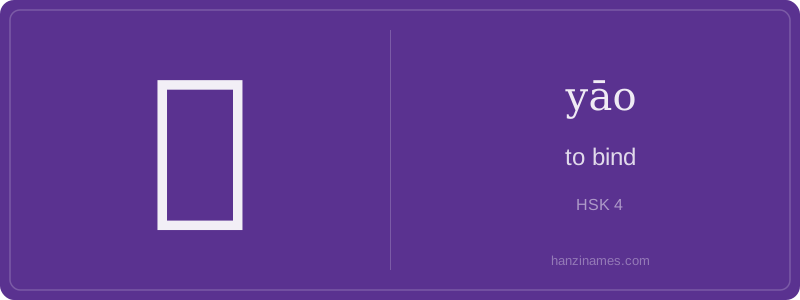
In daily Chinese, 约 most commonly appears in the verb 约会 (yuēhuì, 'to have a date') and the prefix 约 (yuē) meaning 'approximately' (e.g., 约50人, 'about 50 people'). It’s also central to formal terms like 契约 (qìyuē, 'contract') and 自约 (zìyuē, 'self-restraint'), reflecting its enduring sense of binding agreement or measured limit. Historically, it appears over 200 times in the Mawangdui Silk Texts (2nd c. BCE) governing ritual conduct and social obligations.
The character’s form combines the silk radical (纟) — indicating binding or connection — with 勺 (sháo, 'ladle'), a phonetic component. No oracle bone or bronze script form survives, but its earliest secure appearance is in Warring States bamboo manuscripts, where it consistently denotes stipulated limits or mutual commitments—not physical weighing.
As an archaeologist sifting through bamboo slips from the Warring States period, I found 约 etched not as a verb meaning 'to weigh,' but as a binding covenant—its silk-thread radical (纟) wrapping around a contracted agreement. The character’s earliest attested use in excavated texts (e.g., Guodian Chu Slips, c. 300 BCE) consistently conveys restraint, stipulation, or measured commitment—not physical weighing. This reveals how ancient scribes repurposed material imagery: silk cords used to bind documents became metaphors for binding promises.
The ‘weighing’ meaning listed in some dictionaries stems from a rare, archaic usage tied to ritual balance scales in Zhou dynasty oaths—where agreements were literally weighed alongside bronze weights to signify fairness and gravity. Yet no oracle bone or bronze inscription confirms this as the primary origin; instead, excavated legal contracts show 约 always functioning as ‘to bind by mutual consent,’ with weight implied metaphorically—not instrumentally.
Modern lexicography mistakenly foregrounds ‘to weigh’ due to isolated classical glosses, but paleographic evidence overwhelmingly supports ‘to bind, restrict, or stipulate’ as the core semantic anchor. Even the phonetic component (勺 sháo, ‘ladle’) likely evokes measurement *by volume*—not mass—echoing ancient grain-rationing systems where agreements were quantified by scoops, not scales. Thus, 约 is less about physics and more about calibrated obligation.
Example Sentences
Common Compounds
Similar Characters — Don't Mix These Up
Your First Step into Chinese Culture: Get a Chinese Name
Every journey into Chinese begins with a name. Use our free Chinese name generator to create a meaningful, personalized Chinese name that fits you perfectly.
Get My Chinese Name →