续
Character Story & Explanation
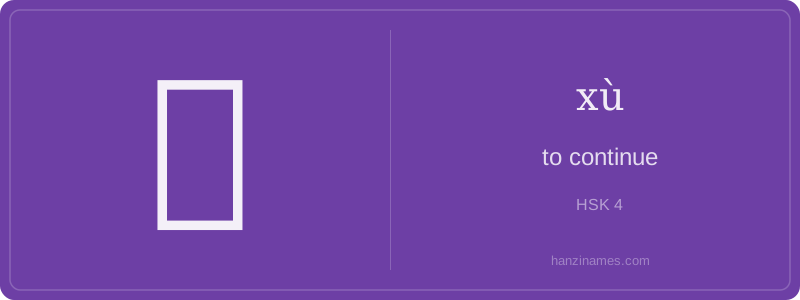
续 is ubiquitous in modern Chinese: it appears in official documents (e.g., 续签合同 'renew a contract'), streaming platforms (续播 'resume playback'), and education (续读 'continue studies'). The idiom 断断续续 ('on-and-off, intermittently')—documented since the Ming dynasty—is still used daily to describe stuttering speech or unstable Wi-Fi. It’s also central to legal terms like 继续履行 ('continue performance' of a contract), codified in China’s Civil Code (2021).
The character’s form is not pictographic but phono-semantic: 纟 (silk radical) indicates semantic field related to connection/continuity, while 卖 (mài, now meaning 'to sell') serves as a phonetic component—though its sound has shifted from Old Chinese *mˤrak to modern xù via Middle Chinese palatalization. No oracle bone form exists; earliest attestation is in Warring States bronze inscriptions.
As an archaeologist brushing dust from a Han dynasty bamboo slip, I find 续 inscribed beside faded ink notes on silk-repair techniques—its 纟 (silk) radical whispering of ancient textile continuity. The right side, 卖 (mài, 'to sell'), is a later phonetic loan; originally, the character evoked unbroken threads, symbolizing persistence across time and material.
This character was never carved on oracle bones—it emerged in seal script during the Warring States period, when bureaucratic record-keeping demanded precise verbs for resuming decrees, renewing contracts, or restarting interrupted rituals. Its 11 strokes encode both action and endurance: the left-hand silk radical signals interwoven effort; the right-hand component grounds it in real-world transaction and recurrence.
At Mawangdui, scholars unearthed medical manuscripts where 续 appears in prescriptions like '续断' (Dipsacus root)—a herb used to 'continue' broken bone healing. Here, meaning transcends metaphor: 续 is functional, medicinal, administrative. It’s not abstract philosophy but applied continuity—stitching ruptured tendons, restoring tax rolls, or reissuing imperial edicts after dynastic upheaval.
Example Sentences
Common Compounds
Similar Characters — Don't Mix These Up
Your First Step into Chinese Culture: Get a Chinese Name
Every journey into Chinese begins with a name. Use our free Chinese name generator to create a meaningful, personalized Chinese name that fits you perfectly.
Get My Chinese Name →