羞
Character Story & Explanation
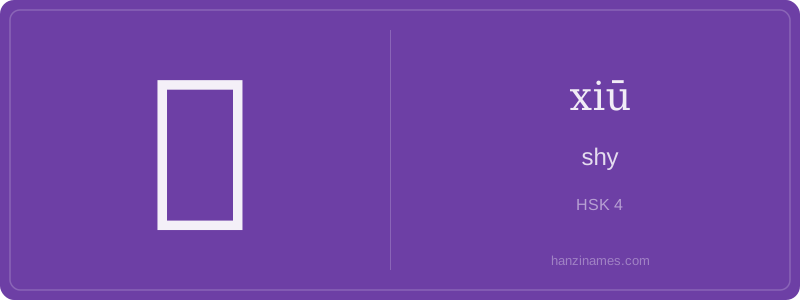
羞 appears frequently in modern spoken and written Chinese, especially in fixed expressions like 羞愧 (xiūkuì, 'ashamed'), 羞辱 (xiūrǔ, 'to humiliate'), and the colloquial interjection 羞死了 (xiū sǐ le, 'I’m so embarrassed!'). It’s a key component in HSK 4 vocabulary and appears in standardized tests, news reports on social misconduct, and literature depicting moral conflict. Historically, it was used in texts like the *Book of Rites* (Lǐjì) to denote ritual shame when failing filial or ceremonial duties.
The character combines 羊 (yáng, 'sheep') on top—a radical reflecting its ancient link to sacrificial offerings—and the bottom component 丑 (chǒu, 'ugly' or 'second Earthly Branch'), which here functions phonetically (xiū shares sound features with chǒu in Old Chinese). No oracle-bone form survives, but bronze inscriptions show early forms with sheep + hand-like elements, confirming its ritual origin—not a pictograph of emotion, but of offering gone wrong.
The Chinese character 羞 (xiū) carries the core meaning 'shy' or 'embarrassed', but its semantic range is richer than English 'shy'. While 'shy' often implies quiet timidity, 羞 emphasizes a visceral, self-conscious discomfort—especially in social contexts where one feels exposed, inadequate, or violates norms. It’s less about temperament and more about momentary emotional recoil from perceived judgment or impropriety.
In classical usage, 羞 originally meant 'to offer sacrificial meat' (from its 羊 'sheep' radical), linking shame to ritual failure or moral shortcoming—suggesting that embarrassment arises not from personality, but from falling short of communal or ethical expectations. This contrasts with Western individualistic views where shyness is often framed as an innate trait rather than a relational breach.
Culturally, Chinese speakers use 羞 more readily than English speakers use 'shy'—e.g., 羞死了 (xiū sǐ le, 'I’m dying of embarrassment!') expresses exaggerated, humorous mortification common in daily banter. Unlike Western therapeutic discourse that may pathologize shyness, 羞 in Chinese is neutral-to-softly negative: it signals awareness, humility, or even endearing vulnerability—not dysfunction.
Example Sentences
Common Compounds
Similar Characters — Don't Mix These Up
Your First Step into Chinese Culture: Get a Chinese Name
Every journey into Chinese begins with a name. Use our free Chinese name generator to create a meaningful, personalized Chinese name that fits you perfectly.
Get My Chinese Name →