羽
Character Story & Explanation
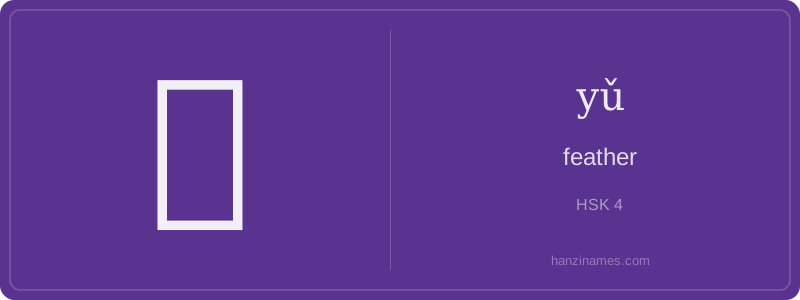
羽 is widely used in modern Chinese for concepts tied to lightness, agility, and elite status—most notably in sports (e.g., 羽毛球 yǔmáoqiú, 'badminton', literally 'feather-ball') and education (e.g., 羽翼 yǔyì, 'wings', metaphorically 'supporters' or 'protégés'). It appears in idioms like 毛羽未丰 (máoyǔ wèi fēng, 'feathers not yet full'), describing someone inexperienced—documented since the Warring States period in texts like the Zhan Guo Ce.
This character originated as a clear pictograph in oracle bone script (c. 1200 BCE): two symmetrical, simplified wing shapes side-by-side, representing paired feathers. Bronze inscriptions refined it into the six-stroke form still used today—preserving its visual essence across 3,200 years.
The character 羽 (yǔ) embodies more than avian anatomy—it is a quiet vessel of Chinese cosmology, where lightness, ascent, and transcendence converge. In Daoist thought, feathers symbolize liberation from earthly weight; in classical poetry, they evoke the fleeting grace of time or the soul’s unbound flight. This resonance transforms 羽 from mere noun to metaphysical motif—appearing in texts like the Zhuangzi, where feathered imagery underscores freedom beyond rigid convention.
Feathers also anchor social harmony: ancient ritual music (雅乐 yǎyuè) used feathered fans (羽扇 yǔshàn) to signify refinement and moral poise. The character thus reflects a worldview where natural phenomena are ethically charged—beauty is never neutral, and even a single plume carries cultural gravity. Its symmetry and delicate strokes visually echo this balance between fragility and intentionality.
Unlike Western binaries of matter vs. spirit, 羽 bridges them: physically light yet culturally dense, biologically ephemeral yet ritually enduring. It appears in martial arts (e.g., ‘feather-weight’ techniques emphasizing softness-over-force) and calligraphy (where brushstrokes mimic feather’s tapering resilience). To learn 羽 is to grasp how Chinese thought embeds philosophy in the tangible—turning biology into ethics, anatomy into aspiration.
Example Sentences
Common Compounds
Similar Characters — Don't Mix These Up
Your First Step into Chinese Culture: Get a Chinese Name
Every journey into Chinese begins with a name. Use our free Chinese name generator to create a meaningful, personalized Chinese name that fits you perfectly.
Get My Chinese Name →