联
Character Story & Explanation
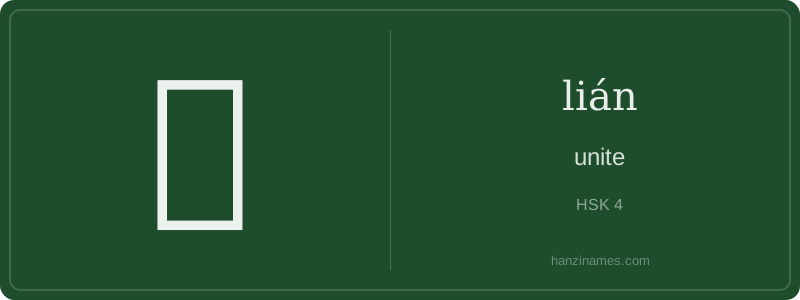
联 is deeply embedded in modern Chinese life: it appears in official terms like 中美联合声明 (Zhōng-Měi liánhé shēngmíng, 'China–US Joint Statement'), in daily communication (联系朋友, 'contact a friend'), and culturally in Spring Festival couplets (春联). A well-documented usage is in the term 联合国 (Liánhéguó) — the United Nations — adopted in 1945 when China became a founding member, cementing 联 as the standard character for international alliance.
The character’s earliest attested form appears in seal script (c. 3rd century BCE), where it combined 耳 (as a phonetic marker, approximating *kʷrən) and 关 (as semantic, implying 'binding' or 'interlocking'). While no oracle bone form survives, its structure stabilized by the Han dynasty — reflecting how early Chinese conceptualized unity as deliberate, structured linkage, not passive proximity.
Hello students! Today we’ll explore 联 (lián), a key character for expressing connection and cooperation. It appears in many important words like 联合 (liánhé, 'to unite') and 联系 (liánxì, 'to contact'). Though its radical is 耳 (ear), don’t be misled — this isn’t about hearing! The ear radical here is a phonetic component inherited from ancient script forms, while the real meaning comes from the right side (关, guān, originally 'to close' or 'to lock'), suggesting binding or linking things together.
Think of 联 as the glue of relationships — whether between people, organizations, or ideas. In spoken Chinese, lián often carries a positive, intentional sense: not just accidental connection, but purposeful alliance. You’ll hear it in news headlines ('Sino-US joint initiative'), tech terms ('Wi-Fi network connection'), and even festive contexts — like Spring Festival couplets (春联, chūnlián), where matching poetic lines are literally 'linked' in form and meaning.
Remember: 联 is never used alone in modern speech — it always appears in compounds. That’s why mastering common two-character words with 联 is far more useful than memorizing the character in isolation. Its tone is second (rising), so practice saying lián clearly — like the word 'lean' but with a gentle upward lift. And yes, those 12 strokes may look complex, but breaking them into left (耳) and right (关) makes writing much easier!
Example Sentences
Common Compounds
Similar Characters — Don't Mix These Up
Your First Step into Chinese Culture: Get a Chinese Name
Every journey into Chinese begins with a name. Use our free Chinese name generator to create a meaningful, personalized Chinese name that fits you perfectly.
Get My Chinese Name →