胳
Character Story & Explanation
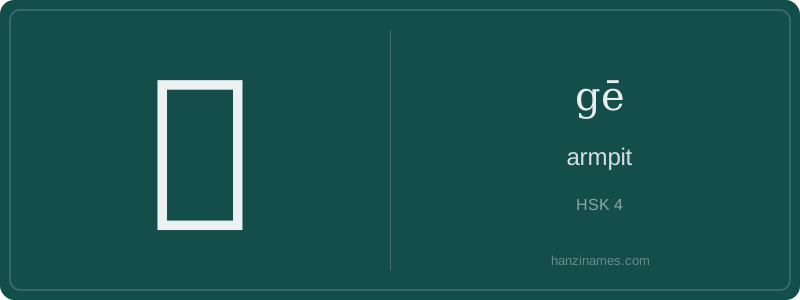
In modern Mandarin, 胳 appears almost exclusively in the word 胳膊 (gēbo, 'arm'), used daily across all regions — from medical contexts ('raise your arm') to casual speech ('my arm hurts'). It’s also found in the classical term 胳肢窝 (gēzhi wō, 'armpit'), still widely understood and used, especially when describing tickling (e.g., 胳肢, gēzhi, 'to tickle'). Historically, the character first appeared in Song dynasty dictionaries like the *Jiyun* (1037 CE), already defined as 'the hollow under the shoulder' — confirming its longstanding anatomical use.
The character is not pictographic; its form evolved from seal script where ⺼ (flesh) combined with 各 (phonetic). No oracle bone or bronze inscriptions contain 胳 — it’s a later, phono-semantic creation. So rather than imagining ancient pictures, picture a real-life moment: a parent gently lifting a child’s arm — saying '举胳膊 (jǔ gēbo)' — that’s where you’ll truly encounter 胳 in action.
Hello students! Today we’ll explore the character 胳 (gē), which means 'armpit'. It’s a Level 4 HSK character — not too common in beginner texts, but essential for understanding body-related vocabulary and natural spoken expressions. Notice its radical ⺼ (the ‘flesh’ or ‘body’ component), which appears in many characters related to the human body, like 脚 (jiǎo, foot) and 肚 (dù, belly). This tells us right away that 胳 is anatomically grounded.
The right side of 胳 is 各 (gè), used here mainly for sound — it gives the pronunciation 'gē' (a slight tonal shift from gè). Don’t confuse this with the standalone word 各 (meaning 'each'), as they share form but not meaning here. Because it’s phonetic-semantic compound, you can remember it as: 'flesh + sound “ge” = armpit'.
While 'armpit' sounds clinical in English, in Chinese, 胳 appears almost exclusively in compounds — never alone. You’ll rarely see it by itself in writing or speech. That’s why mastering common two-character words like 胳膊 (gēbo, arm) is far more useful than memorizing 胳 in isolation. Think of it as a building block — important, but always part of a bigger structure.
Example Sentences
Common Compounds
Similar Characters — Don't Mix These Up
Your First Step into Chinese Culture: Get a Chinese Name
Every journey into Chinese begins with a name. Use our free Chinese name generator to create a meaningful, personalized Chinese name that fits you perfectly.
Get My Chinese Name →