膊
Character Story & Explanation
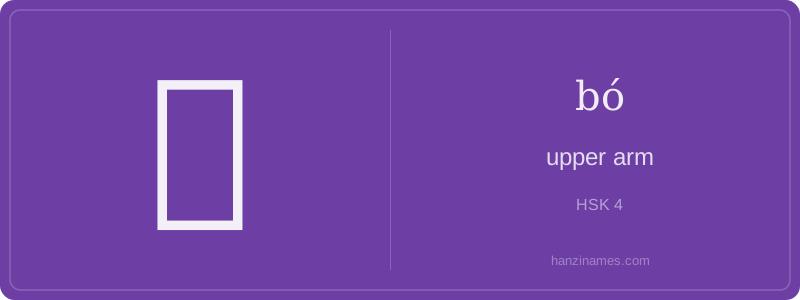
In daily life, 膊 almost never appears alone; it is nearly always paired with 胳 to form 胳膊 (gēbo), the standard spoken word for ‘arm’ across northern and central China. This compound appears in health education materials, sports commentary, and rehabilitation guidelines — e.g., ‘rotate your arms at the shoulder joint’ (转动胳膊). The idiom 赤膊上阵 (chìbó shàngzhèn, ‘go into battle bare-armed’) historically described soldiers entering combat without armor, now used figuratively for direct, unguarded confrontation — documented in Ming-dynasty military literature and still cited in political journalism.
The character 膊 is a phono-semantic compound: the radical ⺼ indicates ‘body/flesh’, while the phonetic component 脅 (xié, ‘to threaten’) approximates the pronunciation bó (though sound shift occurred over time). It first appeared in seal script during the Qin dynasty (3rd c. BCE) and has remained structurally stable — no pictographic origin; its form reflects systematic character formation, not ancient imagery.
The Chinese character 膊 (bó) refers specifically to the upper arm or shoulder region — more precisely, the area from the shoulder joint down to the elbow, often emphasizing the fleshy, muscular part. Unlike English ‘shoulder’, which can denote both the joint and the broader upper limb, 膊 carries anatomical precision and is rarely used metaphorically without compound support. Its radical ⺼ (‘flesh’ or ‘body’) signals its bodily association, anchoring it firmly in physical, corporeal meaning.
In modern Mandarin, 膊 appears most frequently in fixed compounds rather than standalone use — such as 胳膊 (gēbo), the common colloquial term for ‘arm’. While 膊 alone is formal or literary, its presence in compounds reflects a pragmatic linguistic tendency: monosyllabic characters often gain everyday usability only when paired. This contrasts with English, where ‘shoulder’ functions equally well alone or in phrases like ‘shoulder the burden’.
Culturally, the shoulder/upper arm holds symbolic weight in both Chinese and Western traditions — but with divergent emphasis. In Western contexts (e.g., Greek mythology or Christian iconography), the shoulder often signifies burden-bearing (‘bear the cross on one’s shoulders’) or strength (Hercules’ labors). In Chinese usage, 膊 appears more literally and functionally — in martial arts descriptions, medical texts, or idioms about exertion — rarely abstracted into moral metaphors without additional lexical framing.
Example Sentences
Common Compounds
Similar Characters — Don't Mix These Up
Your First Step into Chinese Culture: Get a Chinese Name
Every journey into Chinese begins with a name. Use our free Chinese name generator to create a meaningful, personalized Chinese name that fits you perfectly.
Get My Chinese Name →