脏
Character Story & Explanation
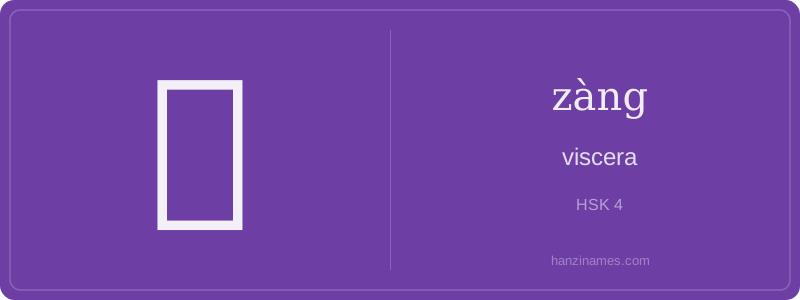
In modern Mandarin, 脏 (zàng) is used almost exclusively in medical, biological, or traditional Chinese medicine (TCM) contexts to denote internal organs—especially in compound terms like 五脏 (wǔ zàng, 'five viscera': heart, liver, spleen, lung, kidney). It appears in standardized TCM textbooks, HSK 4+ health-related dialogues, and official health ministry publications. A well-documented idiom is 五脏六腑 (wǔ zàng liù fǔ), referring collectively to all major internal organs and used metaphorically for deep, visceral emotion ('shook me to my core').
The character’s form has no verified pictographic origin—it evolved from seal script (c. 3rd c. BCE), where ⺼ + 庄 was already a phono-semantic compound. No oracle bone inscriptions contain 脏; its earliest attested form is in Han dynasty bamboo slips. Today, Chinese learners first encounter it in HSK 4 vocabulary lists under 'human body', often paired with diagrams of organ systems in textbooks like *HSK Standard Course*.
As a linguistic detective, I begin with the character’s radical: ⺼ (the ‘flesh’ or ‘body’ radical), which appears on the left and signals a connection to the human body. This radical is a consistent marker for anatomical terms—think 肝 (liver), 肺 (lung), and 心 (heart). The right side, 庄 (zhuāng), originally meant ‘village’ or ‘manor’, but here serves phonetically, approximating the ancient pronunciation of zàng. Over time, this phonetic component stabilized the reading while the meaning narrowed to internal organs.
The dual pronunciation tells a story of semantic divergence: zàng refers strictly to internal organs (viscera), while zāng means ‘dirty’—a homophone that evolved separately, likely through folk etymology and sound-based borrowing. Though written identically in modern script, the two readings belong to distinct lexical families. Historical dictionaries like the *Shuōwén Jiězì* (121 CE) list only the zàng reading for viscera, confirming its original medical-anatomical use.
This duality reflects how Chinese orthography preserves historical layers: one shape encodes two unrelated meanings via sound and context. Unlike alphabetic scripts, where spelling often splits for homophones (e.g., ‘bear’/‘bare’), Chinese retains shared glyphs when pronunciation overlaps—even across semantic domains. Thus, 脏 is not a ‘mistake’ but a fossilized intersection of phonology, anatomy, and lexical evolution—where medicine and morality (clean/dirty) converged accidentally in writing.
Example Sentences
Common Compounds
Similar Characters — Don't Mix These Up
Your First Step into Chinese Culture: Get a Chinese Name
Every journey into Chinese begins with a name. Use our free Chinese name generator to create a meaningful, personalized Chinese name that fits you perfectly.
Get My Chinese Name →