葡
Character Story & Explanation
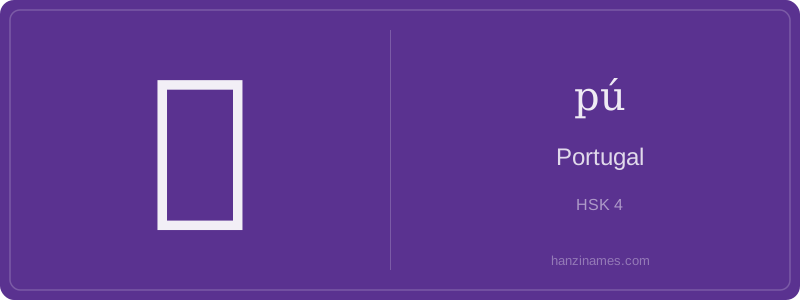
葡 is almost exclusively used in the compound 葡萄牙 (Pútáoyá) — the official Mandarin name for Portugal — appearing in news reports, diplomatic documents, travel guides, and bilingual signage. It does not occur independently in modern usage; no HSK or government word list treats 葡 as a standalone lexical item. Historically, the term dates to the Ming Dynasty (16th c.), when Portuguese traders arrived in Macau; the name was phonetically transcribed using existing characters with similar sounds, a common practice for foreign terms.
The character 葡 originated as a phonetic variant for grape-related terms: its earliest attestations (e.g., in Tang-era texts) appear in 葡萄 (pútáo, 'grape'), borrowed via Central Asian languages from Old Persian *būdāw*. The grass radical 艹 confirms its original botanical sense — a documented semantic anchor. Today, Chinese speakers encounter 葡 only in 葡萄牙 or 葡萄, never in isolation.
The Chinese character 葡 (pú) is a phonetic-semantic compound, where the grass radical 艹 signals a botanical association — historically tied to grapes (葡萄, pútáo), not Portugal. Its use for 'Portugal' is purely phonetic: 'pú' approximates the first syllable of 'Portugal' in Mandarin, following China’s long-standing practice of using sound-alike characters for foreign place names (e.g., 美 for 'America', 英 for 'England'). This reflects linguistic pragmatism over semantic logic.
Unlike Western alphabetic systems where 'Portugal' directly spells the name, Chinese uses monosyllabic characters as building blocks. 葡 never stands alone meaning 'Portugal' — it always appears in compounds like 葡萄牙 (Pútáoyá), mirroring how English uses 'Port.' as an abbreviation but never 'Port' solo to mean the country. This highlights Chinese’s reliance on multi-character units for precision and disambiguation.
Western equivalents include acronyms (e.g., 'UK' for United Kingdom) or truncated forms ('Aussie' for Australia), but those are informal or colloquial. In contrast, 葡萄牙 is formal, standardized, and universally used in media, diplomacy, and education — much like 'FR' in ISO country codes, yet fully lexicalized in speech and writing. The character 葡 itself is rarely isolated, underscoring Chinese’s morphosyllabic nature: meaning emerges from context, not single glyphs.
Example Sentences
Common Compounds
Similar Characters — Don't Mix These Up
Your First Step into Chinese Culture: Get a Chinese Name
Every journey into Chinese begins with a name. Use our free Chinese name generator to create a meaningful, personalized Chinese name that fits you perfectly.
Get My Chinese Name →