艺
Character Story & Explanation
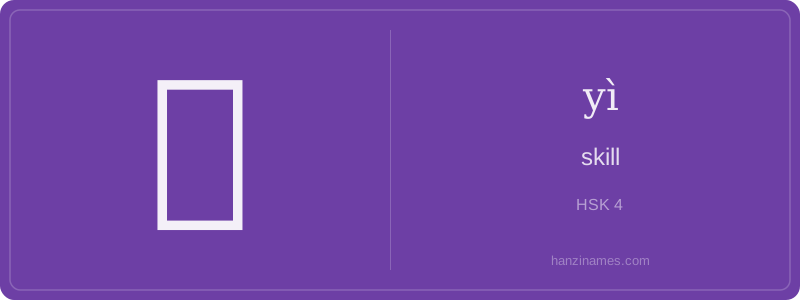
艺 appears frequently in modern Chinese life: in school curricula (艺术课, yìshù kè, 'art class'), entertainment industry titles (艺人, yìrén, 'performer'), and official policy (文化产业, wénhuà chǎnyè, 'cultural industry'). A widely used idiom is 多才多艺 (duōcái duōyì), meaning 'highly talented and skilled'—often applied to scholars or artists praised for versatility across disciplines. Historically, 艺 was central to imperial civil service examinations, where mastery of calligraphy, poetry, and ritual formed part of the 'cultivated person’s skill set.'
The character’s earliest attested form appears in bronze inscriptions of the Western Zhou (c. 1046–771 BCE), where it depicted a hand holding a plant—symbolizing cultivation and nurture. Though its oracle bone form is lost, the seal script clearly shows the 艹 (grass/plant) radical above the phonetic component 乙 (yǐ), indicating both semantic association with growth and controlled development, and phonetic guidance for pronunciation.
The character 艺 (yì) embodies a profound Chinese cultural ideal: skill is not merely technical proficiency, but the harmonious fusion of discipline, aesthetic sensibility, and moral cultivation. Rooted in the grass radical (艹), it originally referred to cultivated plants—suggesting that mastery, like agriculture, requires patience, nurturing, and alignment with natural rhythms. This reflects the Confucian view that true artistry arises from inner virtue expressed through disciplined practice.
In classical China, ‘art’ (艺) was one of the Six Arts (六艺)—rites, music, archery, charioteering, calligraphy, and mathematics—essential for the cultivated scholar-gentleman (junzi). Skill here was never divorced from ethics; archery tested both precision and integrity, music embodied harmony and social order. Thus, 艺 signifies competence imbued with purpose, responsibility, and refinement—not just ‘what you can do,’ but ‘how well and why you do it.’
Modern usage preserves this depth: 艺术 (yìshù, ‘art’) implies creative expression grounded in technique and tradition, while 艺人 (yìrén, ‘performer’) carries connotations of dedication and training, not celebrity alone. Even in education, ‘arts and crafts’ (美术与手工) are taught as pathways to focus, patience, and respect for process—reinforcing that skill, in the Chinese worldview, is a form of quiet wisdom made visible through action.
Example Sentences
Common Compounds
Similar Characters — Don't Mix These Up
Your First Step into Chinese Culture: Get a Chinese Name
Every journey into Chinese begins with a name. Use our free Chinese name generator to create a meaningful, personalized Chinese name that fits you perfectly.
Get My Chinese Name →