处
Character Story & Explanation
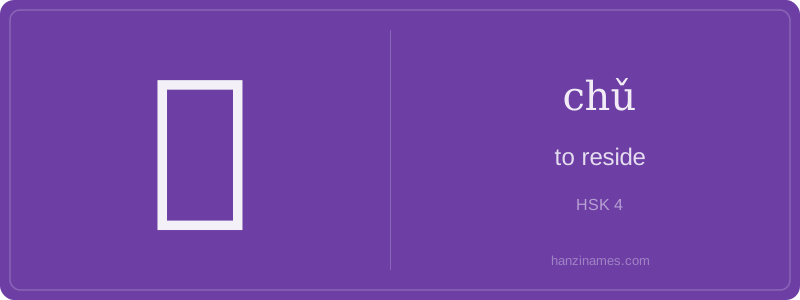
处 is ubiquitous in modern Chinese: from bureaucratic terms like 办公处 (bàngōng chù, 'office') and 派出所 (pàichūsuǒ, 'police station') to idioms like 设身处地 (shè shēn chǔ dì, 'to put oneself in another’s position'). It appears in classical texts such as the *Analects* (13.18): '君子易事而难说也…其使人也,器之。小人难事而易说也…其使人也,求备焉。' — where 处 governs relational conduct. HSK Level 4 learners encounter it in contexts requiring nuanced understanding of stance and location.
The character evolved from seal script, where 夂 (zhǐ) — a radical indicating movement toward or arrival — combines with 丶 (a dot representing a point of focus or settlement). No pictographic origin survives; its form reflects abstract conceptual synthesis: arrival + point = intentional presence. Today, Chinese students practice its five-stroke order daily: 撇 (piě), 横折 (héng zhé), 横 (héng), 撇 (piě), 点 (diǎn).
The character 处 (chǔ) embodies a profound Chinese worldview centered on relational presence—not mere physical location, but intentional, harmonious dwelling within dynamic contexts. Its dual pronunciation reflects a core philosophical duality: chǔ as verb signifies active, mindful engagement—choosing where and how to stand in life’s relationships, responsibilities, and moral landscapes. This resonates with Confucian ideals of *li* (ritual propriety) and *zhongyong* (the Mean), where 'residing' is an ethical act of balance.
When pronounced chù, it shifts to a noun meaning 'place' or 'location', yet even then carries connotation of significance—'a place that matters'. Unlike English 'place', which can be neutral or inert, 处 implies human resonance: a site shaped by memory, function, or feeling. Ancient texts like the *Zuo Zhuan* use 处 to denote not just geography, but spheres of authority and moral accountability—where one ‘takes up residence’ in duty.
This duality mirrors Daoist and Buddhist thought: to 'reside' (chǔ) is to settle without clinging, to occupy space while remaining fluid. In daily speech, saying 我处在学习中 (wǒ chǔ zài xuéxí zhōng, 'I am residing in learning') expresses ongoing, embodied participation—not passive enrollment, but immersive, situated growth. Thus, 处 reveals a worldview where identity is co-constituted through mindful placement in time, relationship, and responsibility.
Example Sentences
Common Compounds
Similar Characters — Don't Mix These Up
Your First Step into Chinese Culture: Get a Chinese Name
Every journey into Chinese begins with a name. Use our free Chinese name generator to create a meaningful, personalized Chinese name that fits you perfectly.
Get My Chinese Name →