卫
Character Story & Explanation
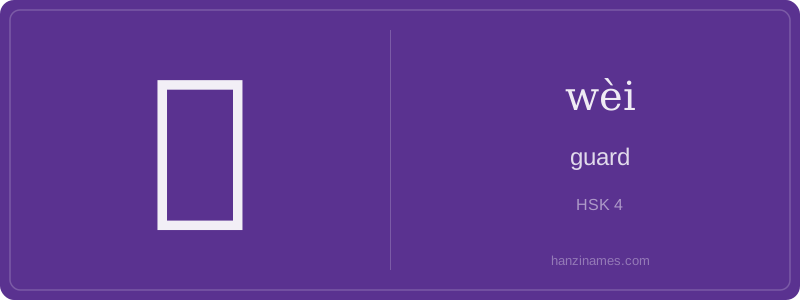
In daily life, 卫 most commonly appears in compound words like 卫生 (wèishēng, 'hygiene'), 卫星 (wèixīng, 'satellite'), and 保卫 (bǎowèi, 'to defend'). It’s also used in proper nouns: the historical State of Wèi is frequently referenced in textbooks, museum exhibits (e.g., at the Henan Museum in Zhengzhou), and idioms such as 卫国戍边 (wèiguó shùbiān, 'defend the nation and garrison the border'), a phrase revived in recent years to honor PLA border guards.
The character 卫 is a simplified form of 衛 (traditional), which itself evolved from seal script forms depicting a person holding a halberd (戈) inside an enclosure (韋). Though the modern simplified version lacks pictographic clarity, its three-stroke form 乛一丨 preserves the structural essence of 'enclosure + upright element', symbolizing guarded space—a documented graphic simplification approved in the 1956 PRC Character Reform.
The character 卫 (wèi) originally denoted the ancient State of Wèi, a powerful vassal state during the Zhou Dynasty (1046–256 BCE), centered in today’s northern Henan and southern Hebei provinces. Its territory included key cultural sites like Anyang—the Shang capital—and later became a major center of Warring States-era philosophy and military strategy.
Though its historical meaning as a state name is now archaic, 卫 survives robustly in modern Chinese as a semantic root meaning 'to guard' or 'defend'. This semantic shift likely arose because vassal states were expected to protect the Zhou king—thus linking political allegiance with protective duty. The character’s enduring presence reflects how ancient geopolitical concepts evolved into core moral and functional vocabulary.
In contemporary usage, 卫 appears in words related to protection, hygiene, and security—like 卫生 (wèishēng, 'hygiene') and 卫星 (wèixīng, 'satellite', literally 'guarding star'). This evolution mirrors China’s long-standing cultural emphasis on defense, order, and public welfare—values first institutionalized in Zhou feudal governance and still embedded in language today.
Example Sentences
Common Compounds
Similar Characters — Don't Mix These Up
Your First Step into Chinese Culture: Get a Chinese Name
Every journey into Chinese begins with a name. Use our free Chinese name generator to create a meaningful, personalized Chinese name that fits you perfectly.
Get My Chinese Name →