计
Character Story & Explanation
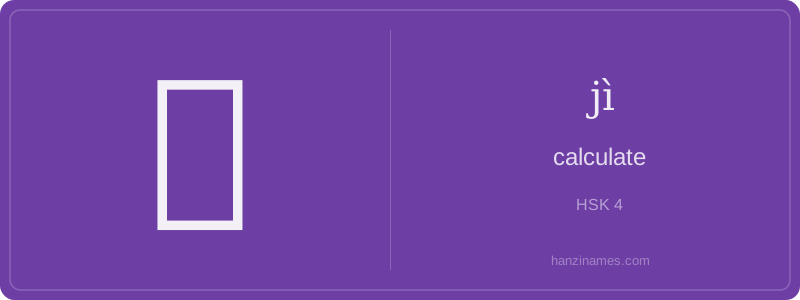
计 has been used for over two millennia in official documents, military strategy texts, and accounting records. The famous Warring States text The Art of War (Sun Tzu, c. 5th century BCE) uses 计 repeatedly in chapters like 'Laying Plans' (始计), where 'calculating odds' precedes battle — showing its deep link to strategic thinking. Today, it’s ubiquitous: in 计算机 (jìsuànjī, 'computer'), 计划生育 (jìhuà shēngyù, 'family planning'), and everyday phrases like '你有什么打算?' (What’s your plan?).
The character evolved from seal script, where the right side resembled a hand holding a tally stick (丨+十), later simplified to 十. While its earliest oracle-bone form is lost, bronze inscriptions confirm its use for 'reckoning' by the Zhou dynasty (1046–256 BCE). Modern usage centers on intentionality: every 'plan' or 'calculation' implies conscious mental effort — not passive observation.
Hello students! The character 计 (jì) is a foundational verb meaning 'to calculate' or 'to plan'. It’s one of the first abstract thinking characters you’ll encounter — not about physical objects, but mental activity: counting, estimating, strategizing. Though simple (just 4 strokes), it carries weight in both math and decision-making contexts. You’ll see it everywhere — from school math problems to business meetings.
Notice its left radical 讠 (speech radical), which tells us this character relates to language, thought, or communication — because planning and calculating are expressed through speech or writing. The right side 十 looks like a cross, but historically it represents a counting tool or tally mark, reinforcing the numeric core. This structure helps you remember that 计 is about *thoughtful, verbalized calculation* — not just arithmetic, but intentional design.
At HSK Level 4, 计 appears frequently in compound words like 设计 (shèjì, 'to design') and 计划 (jìhuà, 'plan'). Don’t confuse it with similar-sounding characters like 记 (jì, 'to record') — the radicals differ (讠 vs. 讠+己), and the meanings diverge sharply. Practice writing it slowly: 1) dot, 2) vertical stroke, 3) horizontal stroke, 4) cross (十). Say 'jì' clearly — like 'jee' with a high, flat tone.
Example Sentences
Common Compounds
Similar Characters — Don't Mix These Up
Your First Step into Chinese Culture: Get a Chinese Name
Every journey into Chinese begins with a name. Use our free Chinese name generator to create a meaningful, personalized Chinese name that fits you perfectly.
Get My Chinese Name →