许
Character Story & Explanation
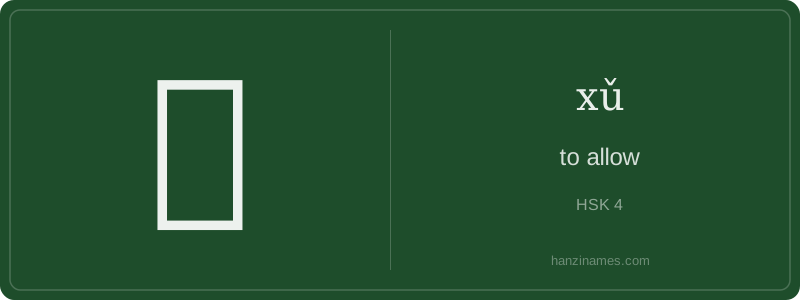
In Beijing’s Chaoyang District, a young entrepreneur checks her phone: a WeChat notification reads '您的食品经营许可已通过' (Your food business license has been approved). The word 许可 (xǔkě) — built around 许 — appears on every official permit issued by China’s State Administration for Market Regulation. This usage is standardized nationwide and legally mandated: no food vendor may operate without this 'xǔ'. Common phrases like 不许拍照 (bù xǔ pāizhào, 'Photography is not permitted') appear on museum signs, and the idiom 许愿 (xǔyuàn, 'to make a wish') retains its ancient link to ritual vows — still practiced at temples like Beijing’s Longtan Park during Lunar New Year.
The character 许 is a late Shang–early Zhou phonosemantic compound. Its left side 讠 (speech radical) signals semantic association with utterance or declaration; the right side 于 was historically a phonetic component (pronounced similarly in Old Chinese). No pictographic origin exists — it was never a drawing of an object — but its structure consistently conveys 'speech-based authorization', aligning with documented usage in bronze inscriptions from the 8th century BCE onward.
The character 许 (xǔ) embodies the idea of permission, authorization, or granting — a subtle but essential concept in Chinese social and institutional life. Unlike blunt commands or prohibitions, 许 carries a tone of conditional consent: 'I allow it, provided certain standards or rules are met.' This reflects Confucian-influenced values where authority is exercised with responsibility, and permission often implies mutual understanding rather than unilateral decree.
In modern usage, 许 frequently appears in formal contexts: government approvals, academic permissions, or legal authorizations. It’s rarely used alone in speech but thrives in compound words like 允许 (yǔnxǔ, 'to permit') and 许可 (xǔkě, 'license'). Its presence signals legitimacy — whether a restaurant’s health certificate bears 许可证 or a university grants study-abroad approval, the character marks an official green light.
Historically, 许 originated as a phonosemantic compound: the left radical 讠 (speech-related) indicates its domain of verbal or written authorization, while the right component 于 (yú, archaic variant of ‘to’) contributes sound and hints at relational action — 'to grant to someone.' Though not among the earliest oracle-bone characters, it appears consistently in Warring States bamboo texts denoting sanctioned appointments or ratified agreements, underscoring its long-standing role in governance and ritual propriety.
Example Sentences
Common Compounds
Similar Characters — Don't Mix These Up
Your First Step into Chinese Culture: Get a Chinese Name
Every journey into Chinese begins with a name. Use our free Chinese name generator to create a meaningful, personalized Chinese name that fits you perfectly.
Get My Chinese Name →