误
Character Story & Explanation
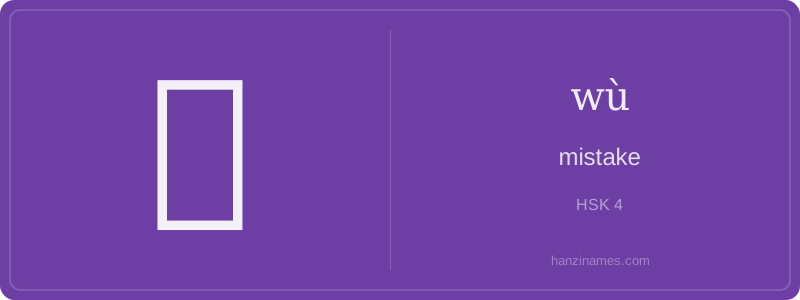
In daily life, 误 appears constantly in formal and semi-formal contexts: news headlines ('误报'—'false report'), medical forms ('误诊'—'misdiagnosis'), and tech interfaces ('操作错误'—'operation error'). It features in classical idioms like 一误再误 (yī wù zài wù, 'one mistake after another'), documented since the Ming dynasty in moral texts warning against compounding errors. The term 误人子弟 (wù rén zǐ dì, 'to mislead students') remains widely used in education debates.
The character’s form has no pictographic origin—it emerged as a phono-semantic compound during the Warring States period. The right side 吴 was selected for sound, not meaning; the left 讠 clearly marks it as speech-related. Modern learners encounter it first in HSK 4 vocabulary like 误会 (wù huì, 'misunderstanding')—a cornerstone term for interpersonal communication in Mandarin.
As a linguistic detective, I begin at the scene: the modern character 误. Its left side, 讠 (the ‘speech’ radical), signals this character’s domain—language, communication, and intention. The right component, 吴, is a phonetic clue, historically pronounced similarly to wù and still used today in names like Wuhan. This structure tells us that 误 isn’t about physical error, but *miscommunication*: a word misheard, a message misdelivered, an assumption misstated.
Tracing further back, 误 appears in early clerical script (Lishu) of the Han dynasty—not in oracle bones or bronze inscriptions—confirming its later emergence as written Chinese matured and semantic precision increased. Its 9-stroke form stabilized by the Tang dynasty, with the speech radical consistently anchoring its meaning in discourse-related fault. Unlike pictographic characters, 误 is a phono-semantic compound: no sun, no tree—just sound + sense, refined over centuries for bureaucratic clarity and literary nuance.
The character’s evolution mirrors China’s administrative history: as imperial examinations demanded precise language use, terms like 误判 (wù pàn, 'wrong judgment') and 误国 (wù guó, 'to harm the state through error') gained prominence in official documents and historical critiques. Even today, 误 carries quiet gravity—it rarely describes trivial typos, but consequential misunderstandings: a mistranslated treaty clause, a misdiagnosed illness, a policy based on flawed data. Its weight lies not in carelessness, but in the gap between intent and impact.
Example Sentences
Common Compounds
Similar Characters — Don't Mix These Up
Your First Step into Chinese Culture: Get a Chinese Name
Every journey into Chinese begins with a name. Use our free Chinese name generator to create a meaningful, personalized Chinese name that fits you perfectly.
Get My Chinese Name →