谈
Character Story & Explanation
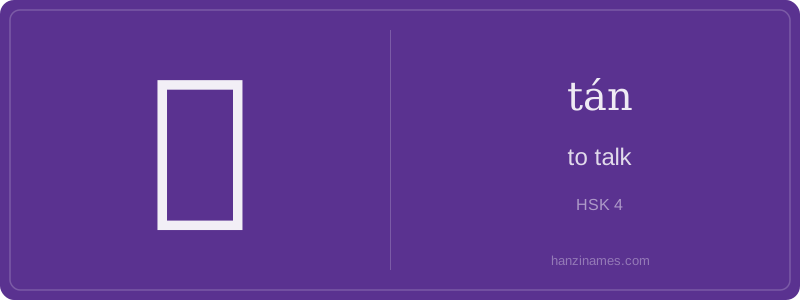
谈 is ubiquitous in modern Chinese: it appears in news headlines (如:中美会谈), business contexts (洽谈合作), education (课堂讨论), and daily life (聊天). The idiom 侃侃而谈 (kǎn kǎn ér tán)—meaning 'to speak fluently and confidently'—dates back to the Analects of Confucius (11.13), describing virtuous scholars’ eloquent yet sincere discourse. Official documents frequently use 谈判 (tán pàn, 'negotiation') and 约谈 (yuē tán, 'summon for talk'), reflecting its institutional weight.
谈 evolved from the ancient character 談, with the simplified form 谈 adopted in 1956 under the PRC’s script reform. Its left component 讠 is the abbreviated speech radical (from 言), and the right 覃 (tán) originally meant 'profound' or 'deep'—suggesting speech that is thoughtful and substantial. No oracle-bone inscription exists for 谈, as it emerged later in bronze and seal scripts; today, Chinese learners practice it early (HSK 4) due to its functional centrality in expressing interpersonal communication.
The Chinese character 谈 (tán) conveys the core idea of 'to speak'—but with nuanced emphasis on conversational, purposeful, or discursive speech, not just vocalization. Unlike English 'speak', which can be neutral or formal (e.g., 'speak at a conference'), 谈 implies dialogue, exchange, or discussion: two or more participants engaging thoughtfully. It appears in contexts ranging from casual chats to high-stakes negotiations, always carrying an undertone of mutual engagement and intentionality.
In Western linguistic frameworks, 'speak' often centers on the speaker’s act (e.g., 'I speak French'), while 谈 foregrounds relational dynamics—what is said *between* people. This mirrors Confucian ideals valuing harmony through respectful discourse; thus, 谈 is rarely used for monologues or commands. Even in modern usage, saying 他谈了半小时 (tā tán le bàn xiǎo shí) means 'He discussed for half an hour'—not just 'spoke', but actively exchanged ideas.
Culturally, 谈 reflects East Asian communication norms where indirectness, face-saving, and contextual awareness shape speech acts. A Western equivalent might be 'engage in dialogue' or 'hold talks', but those phrases are clunky and bureaucratic—whereas 谈 is compact, versatile, and deeply embedded in everyday grammar. Its radical 讠 (speech radical) visually anchors it to language itself, reinforcing that this character isn’t about sound alone, but about meaning-making through interaction.
Example Sentences
Common Compounds
Similar Characters — Don't Mix These Up
Your First Step into Chinese Culture: Get a Chinese Name
Every journey into Chinese begins with a name. Use our free Chinese name generator to create a meaningful, personalized Chinese name that fits you perfectly.
Get My Chinese Name →