译
Character Story & Explanation
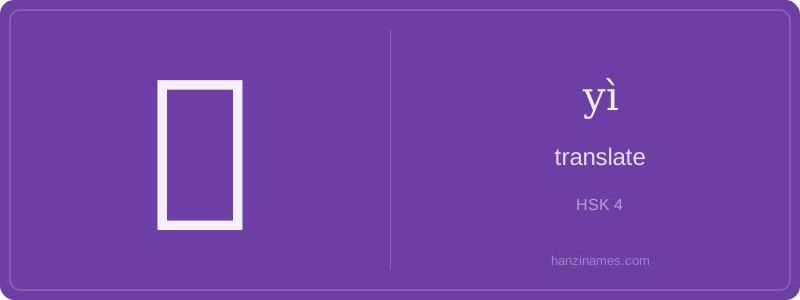
In contemporary China, 译 is ubiquitous: seen on book spines (《百年孤独》译本), university department signs (翻译系), and government press releases (官方译文). It appears in standardized phrases like ‘口译’ (kǒuyì, interpretation) and ‘笔译’ (bǐyì, written translation), both HSK 4+ vocabulary. Historically, the term gained prominence during the Han Dynasty Buddhist sutra translation movement — figures like Kumārajīva (344–413 CE) led massive 译 teams in Chang’an, establishing foundational translation principles still taught today.
The character’s modern form evolved from 尉 (yù) + 讠, but its current right component 驿 (yì, ‘relay station’) reflects historical context: translation was once tied to imperial courier networks where messages were relayed and rephrased across regions. No oracle-bone or bronze inscription exists for 译 — it first appeared in seal script during the Qin-Han transition, consistently denoting mediated language transfer.
The character 译 (yì) embodies the vital act of bridging languages — a quiet but essential force in China’s global engagement. With its ‘speech’ radical (讠) on the left and ‘select/choose’ (译’s right component, originally 驿 yì meaning ‘post station’) on the right, it reflects the deliberate, thoughtful process of choosing precise equivalents across linguistic worlds. In modern China, translators are unsung diplomats: interpreting at Belt and Road forums, localizing K-dramas for Bilibili, or rendering ancient poetry into English for UNESCO publications.
At Beijing Foreign Studies University — home to China’s top translation program — students practice 译 daily, drilling idioms like ‘信达雅’ (xìn dá yǎ: fidelity, expressiveness, elegance), the gold standard set by translator Yan Fu in 1901. The character appears on official documents, publishing house imprints, and AI tool interfaces alike, signaling authority and accuracy. Its seven-stroke form is compact yet intentional — each stroke reinforcing that translation is not substitution, but cultural negotiation.
Unlike mechanical conversion, 译 carries ethical weight: mistranslations can spark diplomatic incidents or distort scientific consensus. During the 2020 pandemic, WHO-China joint reports underwent rigorous 译 review to ensure ‘asymptomatic transmission’ was rendered unambiguously in Chinese. This character thus anchors both technical skill and intercultural responsibility — a 2,000-year-old concept made urgent by globalization, digital media, and China’s rising voice in multilingual discourse.
Example Sentences
Common Compounds
Similar Characters — Don't Mix These Up
Your First Step into Chinese Culture: Get a Chinese Name
Every journey into Chinese begins with a name. Use our free Chinese name generator to create a meaningful, personalized Chinese name that fits you perfectly.
Get My Chinese Name →