质
Character Story & Explanation
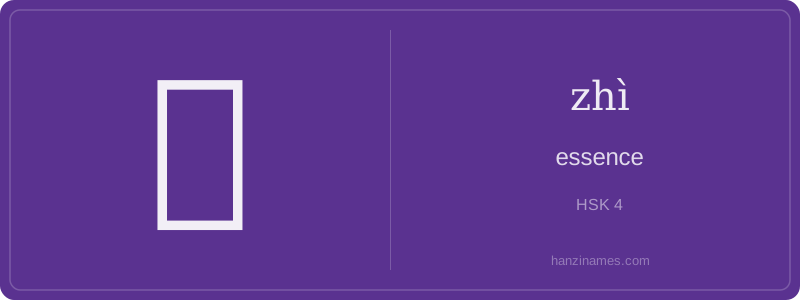
In modern Chinese, 质 most commonly appears in formal, evaluative contexts: product quality (质量, zhìliàng), academic rigor (质询, zhìxún — 'to question critically'), and scientific inquiry (物质, wùzhì — 'matter'). It’s central to HSK 4 vocabulary and appears in idioms like 实事求是 (shìshì qiúshì, 'seek truth from facts'), where 质 underpins the demand for factual authenticity. Government reports, school exams, and consumer standards all rely on this character’s connotation of verifiable essence.
The character’s earliest attested form appears in Warring States bronze inscriptions and Qin bamboo texts, where it depicts a person (人) under a shelter (厂), holding a token—reflecting its original meaning of 'pledge' or 'hostage'. No oracle bone form survives, but excavated legal documents confirm its use in binding agreements by the 4th century BCE.
As an archaeologist brushing dust from a Han dynasty bamboo slip, I find 质 inscribed in clerical script—not as 'character' in the moral sense, but as 'pledge' or 'hostage': a tangible object handed over to guarantee trust. Early texts like the Zuo Zhuan record feudal lords exchanging sons as human 'zhì'—a stark, material anchor for abstract loyalty. This physicality lingers: even today, 质 implies substance you can weigh, test, or verify.
The radical 厂 (hǎn), meaning 'cliff' or 'overhanging rock', originally suggested shelter or enclosure—fitting for something held in custody. The right side 本 (běn, 'root') was later simplified to two strokes and a 'ten' (十), but early forms clearly showed a hand placing an object under protection. Thus, 质 emerged not as an airy ideal, but as a bound, accountable thing—grounded in ritual and law.
By the Tang dynasty, 质 had evolved to mean 'intrinsic nature'—the unchangeable core beneath surface form. Neo-Confucians used it to discuss human nature (性与质), distinguishing innate moral potential from acquired traits. This philosophical pivot—from pledged object to essential quality—mirrors how Chinese thought gradually internalized external commitments into ethical identity. The character’s journey is a microcosm of China’s shift from ritual obligation to introspective virtue.
Example Sentences
Common Compounds
Similar Characters — Don't Mix These Up
Your First Step into Chinese Culture: Get a Chinese Name
Every journey into Chinese begins with a name. Use our free Chinese name generator to create a meaningful, personalized Chinese name that fits you perfectly.
Get My Chinese Name →