中
Character Story & Explanation
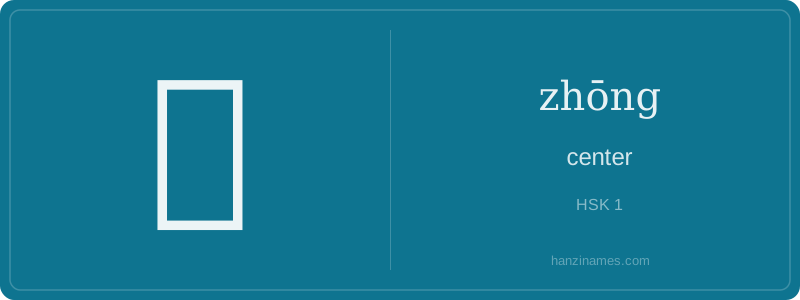
中 is ubiquitous in modern Chinese life: it appears in the official name of the country (中华人民共和国 — People’s Republic of China), on banknotes, government documents, and even smartphone keyboards as the default input for ‘Chinese language’ (中文). Common idioms include 一语中的 (yī yǔ zhòng dì, 'one sentence hits the mark') and 适得其中 (shì dé qí zhōng, 'just right, perfectly balanced'), both attested in classical texts like the *Book of Rites*. The character appears in over 30% of HSK 1–4 vocabulary.
The earliest verified form of 中 appears on Shang dynasty oracle bones (c. 1200 BCE) as a pictograph of a flagpole planted in the center of a circular encampment — symbolizing command, authority, and the focal point of a community. Archaeological inscriptions confirm this usage in military and ritual contexts, making it one of the oldest continuously used characters in written Chinese.
Hello students! The character 中 (zhōng) is one of the most foundational and frequently used characters in Chinese. It literally means 'center' or 'middle' — think of it as the heart of something, whether a physical space, a time period, or an abstract concept. Its simple four-stroke structure makes it easy to write and recognize, and it appears in thousands of words, from place names like Beijing (北京, 'Northern Capital') to everyday expressions like 'in the middle of eating' (吃饭中). As an HSK Level 1 character, mastering 中 is essential for building vocabulary and understanding sentence structure.
Notice that 中 has two standard pronunciations: zhōng (most common, meaning 'center', 'China', or 'during') and zhòng (used when it means 'to hit the target' or 'to strike accurately', as in 中奖 — 'to win a prize'). This dual pronunciation reflects how Chinese uses tone and context to distinguish meaning — a key feature you’ll encounter often. Don’t worry if it feels tricky at first; native speakers also rely heavily on context to know which reading applies.
Visually, 中 looks like a vertical line (丨) with horizontal strokes above and below — imagine a pole standing upright in the center of a square. This layout mirrors its meaning: symmetry, balance, and centrality. In traditional Chinese philosophy, 'the center' carries deep significance — it’s associated with harmony, neutrality, and the ideal position in both space and conduct. So every time you write or read 中, you’re engaging with over two thousand years of cultural thought about balance and order.
Example Sentences
Common Compounds
Similar Characters — Don't Mix These Up
Your First Step into Chinese Culture: Get a Chinese Name
Every journey into Chinese begins with a name. Use our free Chinese name generator to create a meaningful, personalized Chinese name that fits you perfectly.
Get My Chinese Name →