购
Character Story & Explanation
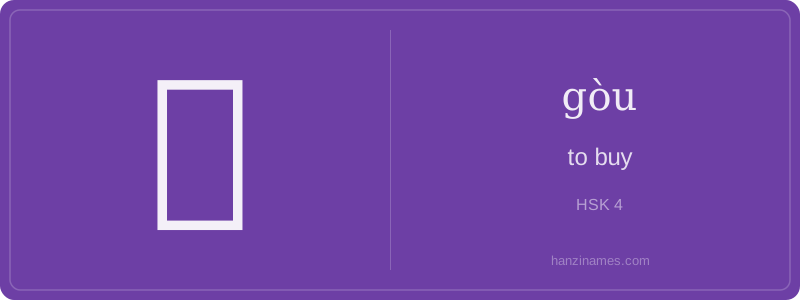
购 is ubiquitous in modern Chinese commerce: it appears on receipts (购物小票), e-commerce interfaces (网购), and official documents like ‘政府采购’ (government procurement). It’s central to the HSK-4 phrase ‘购物’ (gòuwù, ‘shopping’) and the formal idiom ‘收购’ (shōugòu, ‘to acquire’—e.g., companies buying assets). Historically, it appears in the 2nd-century CE dictionary *Shuōwén Jiězì*, defined as ‘以财有所取也’ (‘to obtain something using wealth’)—confirming its monetary, not barter-based, origin.
The character is not pictographic but phono-semantic: ‘贝’ (bèi, ‘cowrie shell’, later ‘money’) is the semantic radical; ‘勾’ (gōu) is the phonetic component, approximating the pronunciation gòu. No oracle bone or bronze inscription of 购 exists—the earliest verified form is in Han clerical script on bamboo slips, showing full structural maturity.
As an archaeologist brushing dust from a Han dynasty bamboo slip, I find 购 inscribed in clerical script—its ‘贝’ (bèi) radical unmistakably echoing ancient cowrie shells, once China’s earliest currency. The right side ‘勾’ (gōu), meaning ‘to hook’ or ‘draw’, suggests the act of drawing value toward oneself: not mere exchange, but intentional acquisition. This duality—shell-as-money + hook-as-action—crystallizes commerce as a deliberate, transactional pull.
Excavations at Chang’an’s Western Market reveal Tang-era ledgers where 购 appears alongside prices in copper coins and silk bolts—proving its use wasn’t abstract, but embedded in regulated trade. Unlike earlier characters for barter (如 ‘易’), 购 implies monetary purchase, reflecting the Qin-Han standardization of coinage and market laws. Its eight-stroke form stabilized by the Eastern Han, shedding earlier variant forms with extra strokes or alternate phonetic components.
The character’s resilience reveals how deeply monetized life had become: from Han tax records listing grain purchases to Song dynasty contracts specifying ‘购书’ (buying books), 购 marks the shift from gift economy to market rationality. Even today, its radical ‘贝’ silently anchors over 70 commerce-related characters—proof that economics, in Chinese script, began not with ledgers, but with shells found on Shandong beaches 3,000 years ago.
Example Sentences
Common Compounds
Similar Characters — Don't Mix These Up
Your First Step into Chinese Culture: Get a Chinese Name
Every journey into Chinese begins with a name. Use our free Chinese name generator to create a meaningful, personalized Chinese name that fits you perfectly.
Get My Chinese Name →