躺
Character Story & Explanation
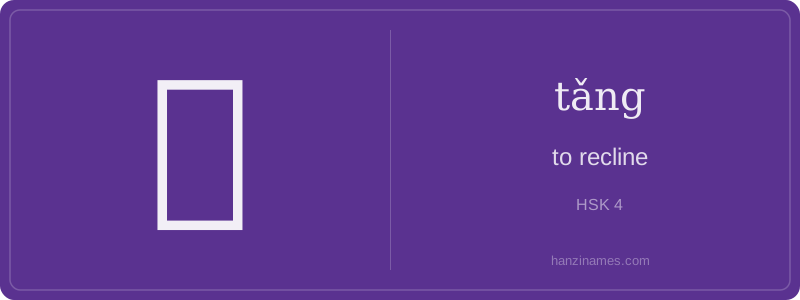
躺 is widely used in modern Mandarin for everyday actions involving horizontal rest: doctors instruct patients to 躺下 (tǎng xià, 'lie down') before examinations; parents tell children to 躺好 (tǎng hǎo, 'lie still') during naps; and the viral phrase 躺平 (tǎng píng, 'lie flat') emerged in 2021 as a socio-political term describing young people opting out of hyper-competitive work culture. It appears in official health guidelines from China’s National Health Commission advising rest positions post-illness.
The character is a phono-semantic compound: the left radical 身 (shēn, 'body') indicates meaning (relating to bodily posture), while the right component 尚 (shàng, 'still, yet') provides phonetic approximation. Though 尚’s pronunciation has drifted from tǎng over millennia, this structure was standardized in the Han dynasty’s *Shuōwén Jiězì* (c. 100 CE)—no oracle bone or bronze script forms survive for 躺, as it entered written use later, likely during the Northern and Southern Dynasties (420–589 CE).
The Chinese character 躺 (tǎng) means 'to recline'—specifically, to lie down horizontally with the body relaxed and supported, often on a bed, couch, or floor. Unlike English verbs like 'lie' or 'lay', which carry grammatical ambiguity and tense complications, 躺 is unambiguously intransitive and action-oriented: it always describes the subject’s own posture change. Its semantic core lies in bodily rest, recovery, or passive stillness—not laziness, but culturally sanctioned pause.
In Chinese discourse, 躺 carries subtle sociolinguistic weight. While 'lying down' in Western contexts may evoke idleness or illness, 躺 is neutral-to-positive: it signals self-care, recuperation, or even strategic withdrawal (e.g., 躺平 'lie flat' as a youth resistance metaphor). This reflects broader East Asian values around balance, conservation of energy (qi), and context-sensitive embodiment—where posture mirrors inner state and social intention.
Western equivalents like 'recline', 'lounge', or 'stretch out' emphasize leisure or luxury (e.g., reclining chairs, spa lounges), whereas 躺 is more functionally grounded: it appears in medical instructions (躺下休息), parenting (宝宝要躺着喂奶), and daily routines (躺床上看书). Even in idioms like 躺着也中枪 ('get hit while lying down'), it conveys vulnerability without moral judgment—highlighting how language encodes cultural attitudes toward rest, agency, and bodily autonomy.
Example Sentences
Common Compounds
Similar Characters — Don't Mix These Up
Your First Step into Chinese Culture: Get a Chinese Name
Every journey into Chinese begins with a name. Use our free Chinese name generator to create a meaningful, personalized Chinese name that fits you perfectly.
Get My Chinese Name →