逛
Character Story & Explanation
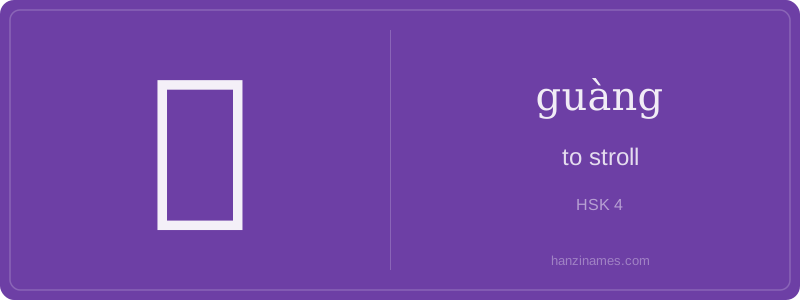
In modern China, 逛 is ubiquitous in daily speech: people 逛商场 (guàng shāngchǎng, 'stroll through a mall'), 逛公园 (guàng gōngyuán, 'stroll in a park'), or 逛夜市 (guàng yèshì, 'browse a night market'). It appears in official tourism slogans—e.g., Beijing’s '逛胡同' ('stroll through hutongs')—and is documented in 20th-century vernacular literature like Lao She’s works, describing Beijingers’ habitual neighborhood wandering. The verb rarely appears in formal writing but thrives in spoken and digital contexts (e.g., WeChat status updates: '今天逛了一下午'—'I strolled all afternoon').
The character’s form combines the radical 辶 (chuò, 'walking') on the left with 狂 (kuáng, 'wild, unrestrained') on the right—a phonetic-semantic compound. While 狂 provides pronunciation (guàng shares the -uàng rhyme with kuáng), its semantic resonance—freedom, lack of constraint—reinforces the idea of unhurried, open-ended movement. No oracle-bone or bronze inscription evidence exists for 逛; it emerged later in vernacular texts, reflecting colloquial speech evolution.
Imagine strolling down Nanjing Road in Shanghai on a warm autumn afternoon—sunlight glinting off glass storefronts, the scent of roasted chestnuts drifting from a street vendor, and crowds moving at an unhurried pace. That effortless, purpose-free walking is precisely what 逛 (guàng) captures: not commuting, not exercising, but leisurely exploring with curiosity and no fixed destination. It’s the embodied rhythm of urban life in China, where wandering is both pastime and cultural practice.
The character 逛 reflects a distinctly Chinese attitude toward time and space: movement as relaxation, not just transit. Unlike ‘walk’ or ‘go’, 逛 implies intentionality without urgency—browsing shop windows, people-watching in a park, or circling a temple courtyard just to absorb the atmosphere. This nuance is why learners often misapply it as a generic verb for ‘go’; context and mindset matter deeply.
At HSK Level 4, 逛 signals a shift from basic action verbs to culturally embedded ones. Its radical 辶 (‘walking’ or ‘movement’) anchors it in physical motion, while the right component (狂, meaning ‘wild’ or ‘unrestrained’) subtly hints at the free-spirited, unstructured nature of the activity. Mastering 逛 helps learners express subtle social behaviors—like joining friends for a relaxed outing—key to sounding natural in everyday Mandarin.
Example Sentences
Common Compounds
Similar Characters — Don't Mix These Up
Your First Step into Chinese Culture: Get a Chinese Name
Every journey into Chinese begins with a name. Use our free Chinese name generator to create a meaningful, personalized Chinese name that fits you perfectly.
Get My Chinese Name →