适
Character Story & Explanation
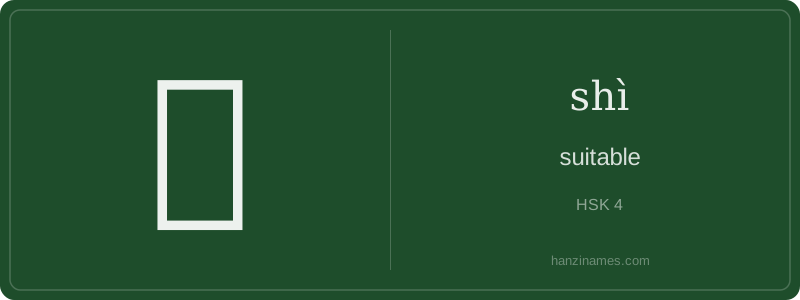
适 is widely used in contemporary Chinese across formal and colloquial registers. It appears in HSK 4 vocabulary, official documents (e.g., ‘适配’—compatibility in tech specs), education policy (‘适龄入学’—enrollment at the appropriate age), and common idioms like ‘适得其反’ (to achieve the opposite effect). Historically, 适 appears in pre-Qin texts such as the *Zuo Zhuan*, where it denotes ‘going to’ or ‘arriving at’—a sense preserved in its radical 辶 (walk/run), reflecting early semantic roots in movement toward suitability.
The character evolved from seal script, where the left side (舌) originally represented ‘tongue’, symbolizing speech or expression, while 辶 indicated motion—suggesting ‘speaking appropriately upon arrival’. Though debated, this structure supports its enduring meaning: fitting action through timely, context-aware response. Today, Chinese learners encounter 适 most often in compound words related to adaptation, compatibility, and appropriateness.
The Chinese character 适 (shì) conveys the core idea of 'fitting'—not just physically, but contextually, functionally, and socially. It implies appropriateness, suitability, and harmony between a thing and its environment or purpose. Unlike English ‘fit’, which often emphasizes physical conformity (e.g., clothing size), 适 carries a stronger normative and relational dimension: something is 适 only when it aligns with standards, conditions, or expectations—whether in education, policy, or daily decisions.
In Western thought, equivalents like ‘apt’, ‘suitable’, or ‘fitting’ exist—but they rarely carry the same philosophical weight. Ancient Greek *kairos* (the right moment) and German *Zweckmäßigkeit* (purposive appropriateness) come close, yet 适 is more pragmatic and less abstract. It appears frequently in official discourse—e.g., ‘适龄儿童’ (school-age children)—where ‘fitting’ is legally and socially defined, not merely descriptive.
Culturally, 适 reflects Confucian ideals of contextual harmony: virtue isn’t absolute, but *appropriately expressed* for one’s role, time, and relationship. This resonates with Aristotle’s ‘golden mean’, yet 适 prioritizes situational alignment over moral balance. In modern China, it underpins policy language (e.g., ‘因地制宜’—adapt measures to local conditions), revealing how deeply ‘fittingness’ is embedded in governance, pedagogy, and social reasoning—not as flexibility, but as disciplined responsiveness.
Example Sentences
Common Compounds
Similar Characters — Don't Mix These Up
Your First Step into Chinese Culture: Get a Chinese Name
Every journey into Chinese begins with a name. Use our free Chinese name generator to create a meaningful, personalized Chinese name that fits you perfectly.
Get My Chinese Name →