醒
Character Story & Explanation
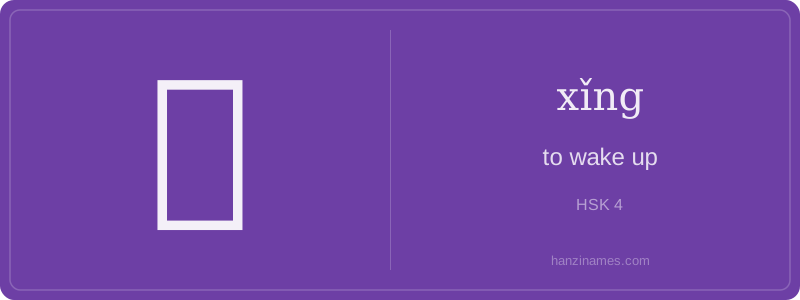
In contemporary China, 醒 is routinely used in health advisories (e.g., '酒后勿驾车,待酒醒后再上路' — 'Don’t drive after drinking; wait until sober'), in education campaigns ('全民觉醒环保意识' — 'National awakening of environmental awareness'), and in common idioms like 恍然大悟 (huǎngrán wùwù) — where 醒 underpins the 'sudden realization' component. It appears in classical texts such as the *Zuo Zhuan* (c. 4th century BCE) describing rulers ‘awakening’ to policy errors.
The character’s form combines 酉 (wine vessel, radical #164) and 星 (xīng, 'star', phonetic component). Per the authoritative *Shuōwén Jiězì* (121 CE), 醒 was defined as 'sobering after drinking', confirming its original physiological sense. The star component likely served phonetic purpose (both 醒 and 星 share the -ǐng/-īng rhyme), not astronomical symbolism.
Imagine waking at dawn in a Beijing hutong—sunlight filters through paper windows, and the aroma of steamed buns drifts from a nearby breakfast stall. As you stir from sleep, your neighbor calls out, 'Xǐng le ma?' ('Are you awake?'). The character 醒 captures that precise moment: not just opening your eyes, but regaining full consciousness, clarity, and presence. It implies an internal shift—from passive rest to active awareness—a nuance deeper than simple physical arousal.
Unlike the English 'wake up', 醒 carries layered connotations: it’s used for sobering up after drinking (e.g., 酒醒), for realizing a truth ('I suddenly woke up to the problem'), and even for historical awakening (as in modern Chinese discourse about national consciousness). Its radical 酉 (yǒu), meaning 'wine vessel', hints at its ancient link to recovering from intoxication—a documented usage in Tang dynasty poetry and medical texts like the *Bencao Gangmu*.
This semantic richness makes 醒 indispensable in both daily speech and literary expression. You’ll hear it in morning greetings, news headlines about social awareness, and classroom discussions on civic responsibility. At HSK Level 4, learners encounter 醒 not only as a verb but as a cognitive marker—signaling mental clarity, moral insight, or societal reflection. Mastering it opens doors to understanding how Chinese language frames consciousness itself—not as a state, but as an act.
Example Sentences
Common Compounds
Similar Characters — Don't Mix These Up
Your First Step into Chinese Culture: Get a Chinese Name
Every journey into Chinese begins with a name. Use our free Chinese name generator to create a meaningful, personalized Chinese name that fits you perfectly.
Get My Chinese Name →