钢
Character Story & Explanation
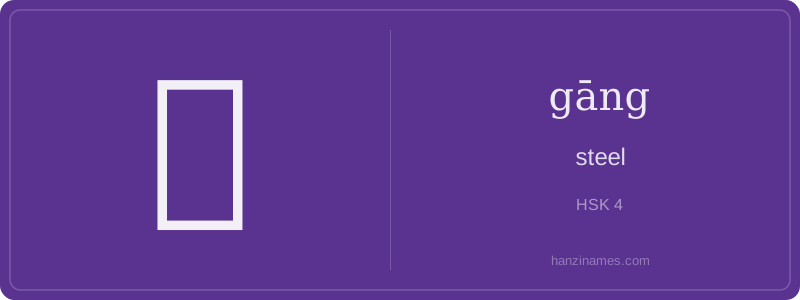
In China’s daily life, 钢 appears ubiquitously: on construction site signage ('钢筋加工区', 'rebar processing zone'), in product labels ('不锈钢', 'stainless steel'), and in national narratives—like the 'Iron and Steel Year' (1958) during the Great Leap Forward, when backyard furnaces aimed to boost steel output. Common phrases include 钢材 (gāngcái, 'steel products') and 钢琴 (gāngqín, 'piano'), the latter adopted in the late 19th century from English 'piano' via Japanese loanword usage.
The character is a phono-semantic compound: 钅 (metal radical) signals category, while 刚 (gāng) provides pronunciation and semantic reinforcement—'rigidity' aligning with steel’s physical property. No oracle-bone or bronze inscription exists for 钢; it emerged later, likely during the Han dynasty or after, as iron/steel production advanced. Today, Chinese students practice it in calligraphy class, tracing its clean, angular strokes to internalize both form and meaning.
Imagine walking through Shanghai’s Pudong district at dawn—sunlight glinting off the steel spires of the Shanghai Tower and Jin Mao Building. Here, 钢 (gāng) isn’t just a character; it’s the silent backbone of modern China’s skyline. With its 钅 (metal) radical and 刚 (gāng, meaning ‘stiff’ or ‘strong’) phonetic component, 钢 literally embodies resilience: metal forged to endure pressure, heat, and time. This duality—material strength and symbolic fortitude—makes it foundational in both engineering and expression.
In Chinese, 钢 carries weight beyond metallurgy. It appears in idioms like 钢筋铁骨 (gāngjīn tiěgǔ, 'steel-reinforced bones'), describing unyielding integrity, and in everyday terms like 钢琴 (gāngqín, 'piano')—a literal 'steel instrument', referencing its tensile wire strings. Unlike English, where 'steel' is purely technical, 钢 evokes cultural associations with discipline, modernization, and even revolutionary spirit—think of the 'Steel Troops' (钢铁部队) celebrated in 1950s propaganda literature.
The character’s nine strokes flow deliberately: first the metal radical 钅 (5 strokes), then 刚 (4 strokes)—a structure mirroring industrial precision. Learners often confuse it with 刚 (gāng, 'just now; firm'), but 钢 always implies material substance. Its HSK Level 4 status reflects how it bridges concrete vocabulary (e.g., construction) and abstract usage (e.g., 钢的意志, 'steel will'). Mastering 钢 opens doors not only to technical texts but also to understanding China’s self-image as a nation forged in fire and resolve.
Example Sentences
Common Compounds
Similar Characters — Don't Mix These Up
Your First Step into Chinese Culture: Get a Chinese Name
Every journey into Chinese begins with a name. Use our free Chinese name generator to create a meaningful, personalized Chinese name that fits you perfectly.
Get My Chinese Name →