队
Character Story & Explanation
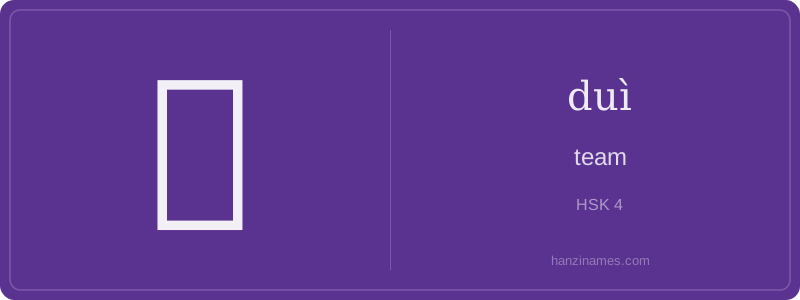
In daily life, 队 is ubiquitous: children join the Young Pioneers (少先队员), commuters wait in line (排队), and sports fans form fan clubs (球迷队). Historically, it appeared in Ming-era military records as a tactical unit of 50–100 soldiers. The idiom 排兵布阵 (pái bīng bù zhèn, 'deploy troops and arrange formations') still uses 队 implicitly — though the character itself rarely appears in classical idioms, it anchors modern compounds like 工作队 (work team) and 救援队 (rescue team), widely documented in state media since the 1950s.
The written form has no pictographic origin. 队 is a later-character creation (post-Qin), first attested in Han clerical script. Its left 阝 (阜) signifies terrain-based organization; the right is a phonetic simplification — not a sun or tree, but a streamlined form of 尊. Today, Chinese learners practice it early because of its frequency in HSK 4 vocabulary like ‘team’, ‘queue’, and ‘squadron’.
As a detective tracing 队’s evolution, I begin at the Han dynasty — not with oracle bones (where 队 is absent), but with clerical script inscriptions and early dictionaries like the Shuōwén Jiězì (121 CE). There, 队 appears as a phonosemantic compound: the left side 阝 (originally 阜, meaning 'mound' or 'hill') hints at spatial organization — troops arrayed on elevated ground for command visibility; the right side 尊 (later simplified to 大 + 丶) was once phonetic, approximating *duì*, though pronunciation shifted over centuries.
By the Tang and Song dynasties, 队 solidified as a military unit term — smaller than an army (军) but larger than a squad (班). Historical texts like the Tang Liudian (Tang Six Codes) document ‘five soldiers = one fire; five fires = one team (队)’. Its four-stroke modern form emerged from regular script simplification: the left 阝 retained its hill-related radical function (signifying grouping in space), while the right collapsed into the streamlined 大 with a dot — not a pictograph, but a cursive reduction with phonetic residue.
The character’s minimalist stroke count (4) belies its semantic weight: it encodes hierarchy, coordination, and collective action. Unlike abstract nouns, 队 always implies human agency and purpose — never used for random clusters (e.g., a pile of rocks), only organized groups: soldiers, students, tourists, even data packets in computing (‘data queue’). This functional specificity makes it a cornerstone of Chinese sociolinguistics — where grammar reflects Confucian ideals of ordered community.
Example Sentences
Common Compounds
Similar Characters — Don't Mix These Up
Your First Step into Chinese Culture: Get a Chinese Name
Every journey into Chinese begins with a name. Use our free Chinese name generator to create a meaningful, personalized Chinese name that fits you perfectly.
Get My Chinese Name →