页
Character Story & Explanation
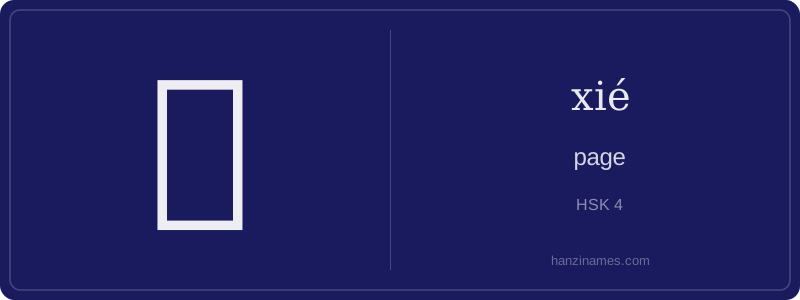
In modern Mandarin, 页 (yè) is overwhelmingly used to mean ‘page’—as in book pages, web pages (网页 wǎngyè), or document pagination. It appears in HSK-4 vocabulary like 页面 (yèmiàn, ‘webpage’) and 页码 (yèmǎ, ‘page number’). Historically, the character appears in early seal script (c. 3rd c. BCE) with a clear pictographic origin: the top component represents the head (头 tóu), and the bottom resembles a person kneeling or bowing—emphasizing the head’s prominence in posture and status.
The earliest verified form, documented in the Shuōwén Jiězì, depicts a person with an exaggerated, rounded head—confirming its origin as a stylized head pictograph. No oracle bone inscriptions of 页 survive, but bronze inscriptions from the Warring States period show consistent head-related usage in titles and ritual contexts.
The character 页 (yè, historically xié) opens a window into the ancient Chinese conception of the human body as a microcosm of cosmic order—where the head, as the highest point, symbolizes authority, consciousness, and spiritual sovereignty. In classical texts like the Shuōwén Jiězì (121 CE), 页 is defined as ‘the front of the head,’ reflecting a worldview in which vertical hierarchy mirrors moral and cosmological structure: heaven above, earth below, and the head as humanity’s celestial interface.
This reverence for the head extends beyond anatomy into social and linguistic realms. Titles like 首领 (shǒulǐng, ‘leader’) and 页眉 (yèméi, ‘page header’) retain the metaphorical elevation implied by 页—literally ‘head of the page.’ Even today, calling someone 一页之才 (yī yè zhī cái, ‘a talent of one page’) subtly invokes the head’s association with brilliance and concise mastery—echoing Confucian ideals of cultivated, upright virtue.
Yet 页 also embodies transformation: from its original meaning of ‘head’ to its dominant modern sense of ‘page,’ it traces China’s shift from oral/ritual culture to textual civilization. A ‘page’ is literally the ‘head’ of a written unit—the first thing seen, the locus of attention. This semantic evolution reveals how Chinese thought layers meaning vertically: the physical head becomes the conceptual head of knowledge, then the structural head of information—a quiet testament to the enduring logic of hierarchy, clarity, and reverence for beginnings.
Example Sentences
Common Compounds
Similar Characters — Don't Mix These Up
Your First Step into Chinese Culture: Get a Chinese Name
Every journey into Chinese begins with a name. Use our free Chinese name generator to create a meaningful, personalized Chinese name that fits you perfectly.
Get My Chinese Name →