饺
Character Story & Explanation
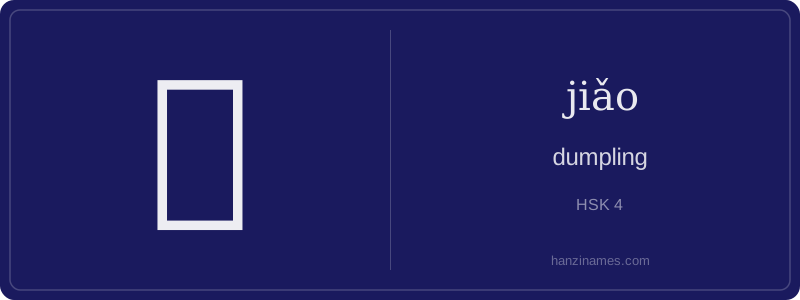
饺 is inseparable from Chinese New Year traditions—families across northern China gather on Lunar New Year’s Eve to make jiaozi together, a practice documented since at least the Ming Dynasty and widely reported in ethnographic studies (e.g., Yang, 2008, Food Culture in China). It appears in fixed phrases like '更岁交子' (gēng suì jiāo zǐ), a homophonic pun linking 'jiaozi' with 'transition of the year', symbolizing auspicious renewal. Restaurants list it as '猪肉饺子' (zhūròu jiǎozi) on menus nationwide, and street vendors sell them by the steamer basket in Beijing’s hutongs and Xi’an’s Muslim Quarter.
The character 饺 has no oracle-bone or seal-script precursor—it emerged later as a simplified, phonosemantic compound. Its form reflects practical literacy needs: 饣 signals food, and 交 provides pronunciation and hints at the folded, interlocked shape. In daily life, Chinese speakers use it exclusively for boiled or pan-fried wheat-dough dumplings with meat/vegetable fillings—not for wontons (hún tún) or baozi (bāozi), which have distinct characters and structures.
As a linguistic detective, I begin at the scene: the character 饺 (jiǎo) first appears in historical texts no earlier than the Song Dynasty (960–1279 CE), long after the oracle bone and bronze scripts had faded. Its absence in ancient inscriptions tells us it’s a relatively late lexical addition—born not from ritual or astronomy, but from the kitchen. The character didn’t emerge to name a philosophical concept or celestial body, but something deeply domestic: folded dough enclosing savory filling. That timing aligns with archaeological and textual evidence of boiled dumplings becoming widespread in northern China during this era.
The radical 饣 (shí), a shorthand for 食 (‘to eat’), anchors the character firmly in the semantic field of food. The right component, 交 (jiāo), serves dual roles: it provides the sound (a phonetic loan—though pronunciation has shifted slightly from Middle Chinese *kæu* to modern jiǎo) and subtly reinforces meaning—‘crossing’ or ‘interlocking’, mirroring how dumpling edges are pleated and sealed. This is not arbitrary fusion; it’s functional orthography: eat + interlock = hand-folded food that holds its contents.
Unlike characters like 日 (sun) or 木 (tree) with clear pictographic roots, 饺 has no visual trace of a dumpling in its strokes. Its design is purely schematic—logophonetic, not pictorial. That makes it a textbook example of how Chinese writing evolved to prioritize efficiency and systematicity over illustration. By the Ming and Qing dynasties, 饺 was standardized in dictionaries like the Zì Huì (1615), cementing its role as the unambiguous, everyday term for meat-stuffed dumplings—distinct from soup dumplings (xiǎolóngbāo) or glutinous rice balls (tāngyuán).
Example Sentences
Common Compounds
Similar Characters — Don't Mix These Up
Your First Step into Chinese Culture: Get a Chinese Name
Every journey into Chinese begins with a name. Use our free Chinese name generator to create a meaningful, personalized Chinese name that fits you perfectly.
Get My Chinese Name →