餐
Character Story & Explanation
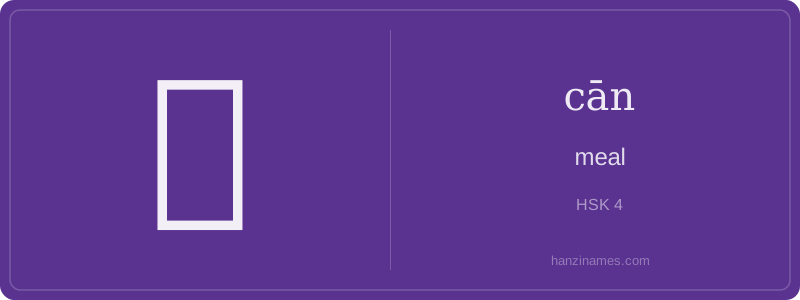
餐 entered standard written Chinese during the late imperial period, appearing frequently in Ming–Qing vernacular literature and official records referring to imperial banquets, military rations, and temple offerings. Today, it’s ubiquitous in compound words like 餐厅 (cāntīng, 'restaurant'), 外卖餐 (wàimài cān, 'takeout meal'), and the formal phrase 用餐 (yòngcān, 'to have a meal'), used in signs, menus, and etiquette guidance across China, Taiwan, and Singapore.
The character is not pictographic nor attested in oracle bone or bronze inscriptions. Its form evolved from seal script, where the left side 食 (food) clearly denotes semantic category, while the right side 残 (cán) serves as a phonetic loan—though its original meaning ('remnant') faded over time. Modern users encounter 餐 most commonly on restaurant signage, food delivery apps, and school lunch notices—always signaling a socially framed, culturally sanctioned moment of eating.
The character 餐 (cān) embodies the Confucian reverence for food as a cornerstone of human relationships and social harmony. In traditional Chinese thought, sharing a meal is never merely biological sustenance—it’s an act of respect, reciprocity, and moral cultivation. The very structure of the character—combining the ‘food’ radical 食 with the phonetic component 残 (cán, originally meaning 'remaining' or 'leftover')—suggests nourishment that sustains life across time, echoing the cultural ideal of frugality and mindful consumption.
Unlike Western notions of meals as functional intervals, 餐 reflects a worldview where timing, setting, and company are inseparable from the food itself. Breakfast (早餐), lunch (午餐), and dinner (晚餐) are not just temporal labels—they encode generational roles, seasonal awareness, and ritual intention. A well-prepared 餐 signifies care; a hastily eaten one may imply neglect—not of hunger, but of relational duty.
This character also reveals how language encodes ethics: the radical 食 appears in words like 饱 (bǎo, 'full'), 饥 (jī, 'hungry'), and 饮 (yǐn, 'to drink'), forming a semantic field centered on embodied humanity. To speak of 餐 is to invoke dignity, hospitality, and continuity—whether serving elders, hosting guests, or packing a child’s lunchbox. Thus, 餐 is less a noun than a quiet ethical verb: 'to honor life through shared sustenance.'
Example Sentences
Common Compounds
Similar Characters — Don't Mix These Up
Your First Step into Chinese Culture: Get a Chinese Name
Every journey into Chinese begins with a name. Use our free Chinese name generator to create a meaningful, personalized Chinese name that fits you perfectly.
Get My Chinese Name →