验
Character Story & Explanation
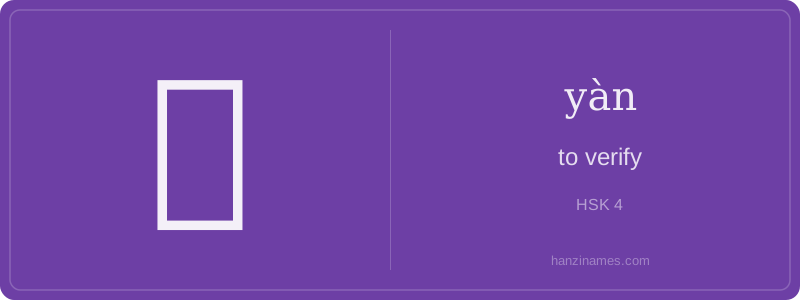
验 is ubiquitous in modern Chinese life: from scanning QR codes to ‘verify health code’ (验健康码) during pandemic controls, to bank ATMs prompting ‘please verify your ID’ (请验身份证). It appears in legal texts (《中华人民共和国电子签名法》 requires electronic signatures to be ‘verified’—需验签), and in the common phrase 验收 (yànshōu), meaning ‘acceptance inspection’ for construction projects or software delivery—mandated by national standards like GB/T 50328.
The character evolved from seal script; its left side 马 (mǎ, ‘horse’) is a phonetic component—not semantic—and its right side 佥 (qiān) originally conveyed ‘collective agreement’ or ‘confirmation’. By the Han dynasty, 验 was standardized in texts like the *Shuōwén Jiězì* (121 CE) as ‘to verify by comparison’, reflecting bureaucratic needs in imperial record-keeping.
验 (yàn) is a versatile verb meaning 'to examine', 'to test', or 'to verify'—emphasizing careful scrutiny to confirm truth, authenticity, or functionality. Unlike English verbs like 'check' or 'inspect', 验 carries a formal, procedural weight: it implies official validation (e.g., ID verification, lab testing, or quality control), not casual observation. Its use often signals institutional authority or scientific rigor—think customs officers scanning passports or engineers validating prototypes.
In Western contexts, 'examination' may evoke academic testing (e.g., exams) or medical diagnostics—but 验 rarely means 'exam' as a noun; instead, it’s the *act* of verifying evidence-based claims. Compare to the Greek-rooted 'verify' (from verus, 'true') or German 'prüfen': like these, 验 prioritizes empirical confirmation over subjective judgment. It’s less about opinion and more about measurable conformity to standards.
Culturally, 验 reflects China’s emphasis on documented legitimacy—seen in digital identity systems (e.g., real-name verification for WeChat Pay) and regulatory compliance (e.g., food safety inspections). This contrasts with some Western traditions where trust may precede verification (e.g., honor-system libraries). Yet both cultures converge in high-stakes domains: FDA drug approval parallels China’s NMPA clinical trial verification—both demand rigorous, repeatable 验 processes grounded in evidence.
Example Sentences
Common Compounds
Similar Characters — Don't Mix These Up
Your First Step into Chinese Culture: Get a Chinese Name
Every journey into Chinese begins with a name. Use our free Chinese name generator to create a meaningful, personalized Chinese name that fits you perfectly.
Get My Chinese Name →