写
Character Story & Explanation
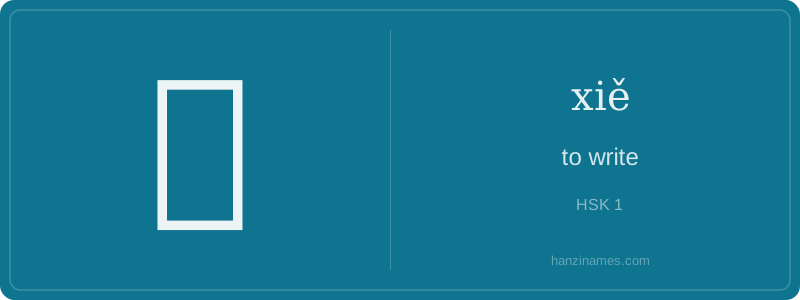
写 is ubiquitous in daily life: students complete ‘homework’ (作业 zuòyè), which always includes writing exercises; official forms require ‘signature’ (签名 qiānmíng), literally ‘sign-writing’; and digital communication still invokes it—e.g., 微信里写句话 (‘write a sentence in WeChat’). A well-known idiom is 一挥而就 (yī huī ér jiù), describing effortless, masterful writing—historically applied to famed calligraphers like Wang Xizhi. The character appears in Tang dynasty texts like the *Qieyun* rhyme dictionary, confirming its standardized use by the 7th century.
The modern form of 写 evolved from the seal script variant of the character 寫 (xiě), meaning ‘to copy out’ or ‘to depict’. While 寫 was used in oracle bone and bronze inscriptions for ‘to pour out’ (as in pouring wine), the simplified 写 emerged in clerical script during the Han dynasty as a shorthand. It is not a pictograph, but a phono-semantic compound: 冖 (cover) + 与 (yǔ, archaic phonetic component), later simplified to 与 → 与-like shape. No verified pictorial origin exists—its power lies in function, not imagery.
The character 写 (xiě) embodies the Chinese reverence for written language as a bridge between thought and reality. Unlike Western notions of writing as mere transcription, 写 carries connotations of inscription, embodiment, and even spiritual imprinting—rooted in ancient practices where writing names or prayers was believed to influence fate. Its simplicity—just five strokes—belies its profound role in education, bureaucracy, and self-cultivation, reflecting the Confucian ideal that moral character is shaped through disciplined writing practice.
In classical Chinese, 写 originally meant 'to pour out' or 'to transfer'—a metaphor for externalizing inner meaning onto paper. This aligns with the Daoist and Buddhist view that language is not static representation but dynamic expression: to write is to manifest intention into form. Even today, calligraphers treat each stroke as an extension of the writer’s qi (vital energy), making 写 a physical meditation rather than mechanical output.
Modern usage reveals how deeply 写 is woven into China’s social fabric: from children practicing characters in ‘writing books’ (写字本) to officials drafting policy documents (起草文件), 写 signifies responsibility, clarity, and authority. The HSK Level 1 placement underscores its foundational status—not just as a verb, but as a cultural gateway. To learn 写 is to begin understanding how Chinese civilization transmits memory, law, poetry, and identity—not through speech alone, but through the deliberate, reverent act of putting ink to paper.
Example Sentences
Common Compounds
Similar Characters — Don't Mix These Up
Your First Step into Chinese Culture: Get a Chinese Name
Every journey into Chinese begins with a name. Use our free Chinese name generator to create a meaningful, personalized Chinese name that fits you perfectly.
Get My Chinese Name →