丽
Character Story & Explanation
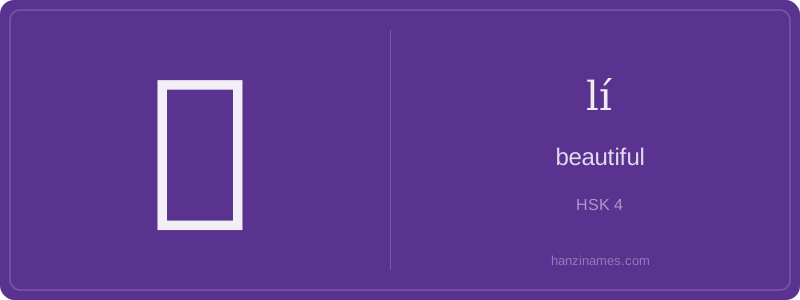
丽 is most commonly used today as an adjective meaning 'beautiful'—in names (e.g., 李丽 Lǐ Lí), advertising ('丽人' lìrén, 'elegant woman'), and phrases like 秀丽 (xiùlì, 'gracefully beautiful'). Historically, it appears in 高丽 (Gāolí), the Tang- to Ming-dynasty Chinese designation for the Korean Goryeo Kingdom, preserved in modern terms like 高丽参 (Gāolíshēn, 'Korean ginseng'). It remains standard in formal diplomacy and historical writing, never colloquial for 'Korea' alone.
The character’s earliest attested form (small seal script, c. 200 BCE) combines 丽 (originally depicting two antlers—symbolizing symmetry and splendor) with 丶 (a dot radical indicating emphasis or completion). Modern simplification reduced it to seven strokes, retaining its core semantic association with luminous elegance—not a pictograph of Korea, but a culturally resonant vessel for historical reference.
The character 丽 (lí) is a fascinating cultural lens: though its primary modern meaning is 'beautiful' or 'lovely,' it also serves as the official Chinese shorthand for Korea—specifically in proper nouns like 朝鲜 (Cháoxiǎn, North Korea) and 韩国 (Hánguó, South Korea), where 丽 appears in historical and diplomatic contexts as part of the classical term 高丽 (Gāolí), the ancient Chinese name for the Goryeo Dynasty (918–1392 CE). This dual role reveals how Chinese lexical tradition preserves geopolitical memory through literary allusion rather than direct naming.
In classical Chinese cosmology, beauty (丽) was never merely aesthetic—it implied harmonious alignment with cosmic order, moral refinement, and luminous clarity. The character’s original seal script form evoked radiant light or elegant symmetry, linking visual splendor to ethical virtue. Thus, when China refers to Korea as 高丽, it invokes not just geography but a historically recognized civilization whose art, governance, and Confucian scholarship were admired as ‘radiantly refined’—a compliment encoded in the character itself.
This duality reflects a broader Chinese worldview: language carries layered time-depth. A single character may simultaneously function as a poetic adjective, a historical toponym, and a diplomatic signifier—without contradiction. 丽 doesn’t ‘mean Korea’ in isolation; it means ‘lovely’ first, and ‘Korea’ only within fixed, historically sedimented compounds. This mirrors how Chinese culture values context over abstraction: meaning emerges from relationship—not dictionary definition, but usage across centuries of texts, treaties, and poetry.
Example Sentences
Common Compounds
Similar Characters — Don't Mix These Up
Your First Step into Chinese Culture: Get a Chinese Name
Every journey into Chinese begins with a name. Use our free Chinese name generator to create a meaningful, personalized Chinese name that fits you perfectly.
Get My Chinese Name →