龄
Character Story & Explanation
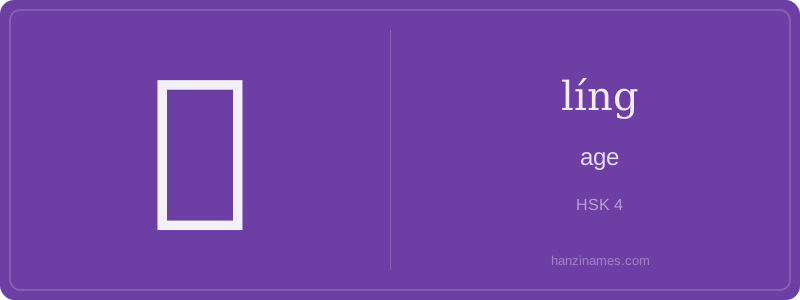
龄 is ubiquitous in modern Chinese administrative language: government forms, HR records, and education policy all rely on it — e.g., the national '义务教育入学年龄' (compulsory education entry age) is strictly defined as 6 years old. It also appears in well-documented idioms like '高龄产妇' (gāolíng chǎnfù, 'advanced maternal age mother'), a term widely used in public health reports since China’s 2015 two-child policy. Legally, '法定退休年龄' (statutory retirement age) is codified in China’s Labor Law.
The character’s form dates to seal script (c. 3rd century BCE), where 齿 (tooth) + 令 (lìng, 'command/order') combined to mean 'the command or measure of life's progression'. Archaeological inscriptions confirm this structure — no oracle-bone version exists, but bronze inscriptions from the Warring States period already show this composition.
Hi students! The character 龄 (líng) means 'age' — specifically, a person’s chronological age or the duration something has existed. It’s not used alone in speech; instead, it appears in compound words like 年龄 (niánlíng, 'age') or 工龄 (gōnglíng, 'years of work experience'). Think of it as a formal, written-word building block — you’ll see it on official forms, ID cards, and school documents, but rarely hear it by itself in casual talk.
Notice its radical: 齿 (chǐ), meaning 'tooth'. This might surprise you! In ancient Chinese, teeth were closely linked to aging — losing baby teeth, getting wisdom teeth, or tooth wear all signaled life stages. So 龄 literally carries the idea of 'time measured by dental development'. Though modern usage is abstract, this radical reminds us how deeply biology shaped early Chinese timekeeping concepts.
As an HSK Level 4 character, 龄 appears frequently in intermediate reading — especially in contexts about education, employment, or demographics. You’ll need it to understand phrases like '退休年龄' (retirement age) or '入学年龄' (school entry age). Don’t confuse it with 年 (nián, 'year') — 龄 always refers to *how many years someone/something has lived or existed*, never just a calendar year.
Example Sentences
Common Compounds
Similar Characters — Don't Mix These Up
Your First Step into Chinese Culture: Get a Chinese Name
Every journey into Chinese begins with a name. Use our free Chinese name generator to create a meaningful, personalized Chinese name that fits you perfectly.
Get My Chinese Name →