制
Character Story & Explanation
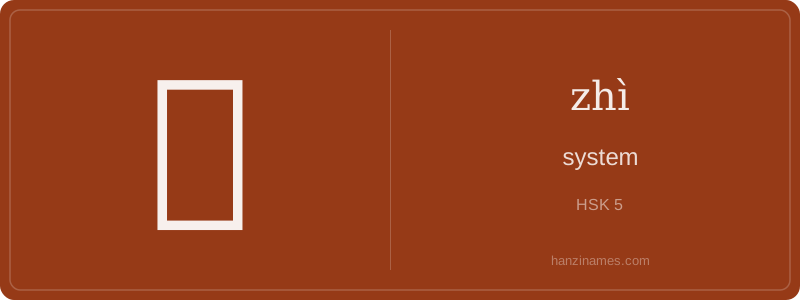
制 has been used for over two millennia to denote authoritative creation—especially in governance and law. In classical texts like the Book of Rites (Lǐjì), 制 appears in phrases like '制礼作乐' ('establish rites and compose music'), reflecting Zhou dynasty efforts to codify social order. Today, it’s ubiquitous in modern China: the National People’s Congress '制定法律' (zhìdìng fǎlǜ, 'enacts laws'), and schools follow '教学制度' (jiàoxué zhìdù, 'teaching system'). Common idioms include '因地制宜' (yīn dì zhì yí, 'adapt measures to local conditions'), where 制 means 'to formulate'.
The character evolved from seal script, where the left part 未 (later simplified to 制’s top) originally represented a hand holding a tool, and the right 刂 ('knife') signified cutting or enforcing boundaries. Though its earliest form isn’t pictographic like 日 (sun), the knife radical consistently signals regulation—cutting away disorder to impose structure.
Hi students! The character 制 (zhì) is a key HSK Level 5 word meaning 'to make', 'to formulate', or 'system'—especially in abstract, institutional contexts. It’s not about physical crafting (like making a chair), but about creating rules, standards, or official frameworks. Think of it as the verb behind laws, regulations, and systems: you ‘formulate’ a policy or ‘establish’ a procedure. Its radical 刂 (the ‘knife’ radical) hints at cutting, shaping, or imposing structure—like carving order out of chaos.
This character appears constantly in formal and administrative language. You’ll see it in news headlines (e.g., 制定法律 — 'enact laws'), government documents, and academic texts. While beginners might confuse it with verbs like 做 (zuò, 'to do/make') or 造 (zào, 'to manufacture'), 制 carries authority and intentionality—it implies deliberate, top-down creation, often by institutions or experts.
Remember: 制 is rarely used alone. It almost always appears in compounds like 制度 (system), 制定 (to formulate), or 制约 (to restrict). Pronunciation is zhì (fourth tone—sharp and falling), like saying 'jih' with a decisive drop. Practice writing it with its 8 strokes—and notice how the right side 刂 anchors the character visually and semantically, reminding us that systems require precision and enforcement.
Example Sentences
Common Compounds
Similar Characters — Don't Mix These Up
Your First Step into Chinese Culture: Get a Chinese Name
Every journey into Chinese begins with a name. Use our free Chinese name generator to create a meaningful, personalized Chinese name that fits you perfectly.
Get My Chinese Name →