形
Character Story & Explanation
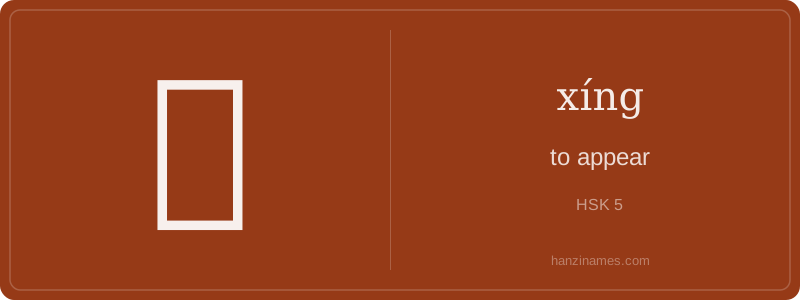
形 is ubiquitous in modern Standard Chinese: it appears in formal registers (e.g., 新形势 xīn xíngshì, 'new situation'), idioms (如火如荼 rú huǒ rú tú — though not containing 形, its usage in phrases like 有形资产 yǒu xíng zīchǎn 'tangible assets' reflects its concrete-abstract duality), and HSK 5 vocabulary like 形成 (xíngchéng, 'to form'). Historically, it appears in pre-Qin texts such as the *Zhuangzi*, where 形神 (xíng-shén, 'form-spirit') debates shaped Chinese medicine and aesthetics.
形 is not a pictograph but a phono-semantic compound: the left side 彡 (shān) is a radical meaning 'ornamental strokes' or 'patterns', hinting at surface appearance; the right side 开 (kāi, 'to open') was simplified from a now-obsolete phonetic component. Its earliest attested form in bronze inscriptions (c. 1000 BCE) already carried meanings of 'shape' and 'manifestation' — confirming its ancient role in denoting tangible emergence.
The Chinese character 形 (xíng) carries the core meaning 'to appear' or 'to take shape' — not merely visual perception, but the emergence of form, essence, or manifestation. Unlike English verbs like 'appear', which often imply sudden visibility, 形 emphasizes ontological emergence: something becoming perceptible *because* it has acquired structure, definition, or presence in reality. It’s deeply tied to classical Chinese cosmology, where 'form' (形) and 'spirit' (神) are complementary poles — what is manifest versus what is intangible.
In Daoist and Confucian texts, 形 frequently appears in contrast with 名 (míng, 'name') or 神 (shén, 'spirit'), highlighting how physical manifestation grounds abstract concepts. Western philosophy — from Plato’s Forms to Kant’s phenomena — grapples similarly with appearance versus essence, yet 形 resists Platonic idealism: here, form isn’t a copy of a perfect idea, but the necessary condition for anything to enter human experience at all.
Culturally, 形 reflects East Asian epistemology: truth is verified through observable manifestation — a person’s 形 (bearing, demeanor) reveals their inner state; a policy’s 形 shows its real implementation. This contrasts with Western legal or rhetorical traditions that may prioritize intent over visible outcome. Thus, 形 is less about 'showing up' and more about 'becoming substantively real' — a subtle but vital distinction learners must grasp to avoid translation pitfalls.
Example Sentences
Common Compounds
Similar Characters — Don't Mix These Up
Your First Step into Chinese Culture: Get a Chinese Name
Every journey into Chinese begins with a name. Use our free Chinese name generator to create a meaningful, personalized Chinese name that fits you perfectly.
Get My Chinese Name →