乙
Character Story & Explanation
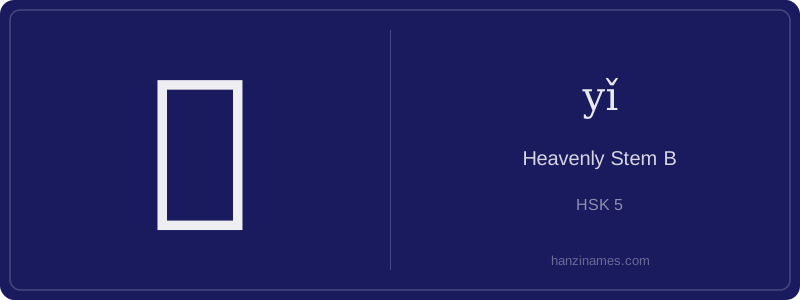
In modern China, 乙 is routinely used to label sections in formal documents — e.g., ‘附件一’ (Annex I), ‘附件二’ (Annex II), or ‘甲方/乙方’ (Party A / Party B) in contracts, real estate deeds, and government forms. This usage derives directly from the Heavenly Stem sequence and remains legally standardized. You’ll also see it in academic settings: university entrance exam answer sheets mark multiple-choice options as 甲、乙、丙、丁 — equivalent to A, B, C, D. Historically, the stems appeared on oracle bones and bronze inscriptions to record dates and rituals.
The character 乙 is not a pictograph with a clear object referent. Its earliest forms (Shang oracle bone script) show a bent line — likely an abstract symbol rather than a depiction of something physical. Scholars agree it was created as a logographic sign for the second stem, with no natural-world referent. So today, Chinese learners associate it most concretely with ‘Party B’ in contracts — a real, daily-use anchor for its meaning.
Hi there! Let’s meet 乙 (yǐ) — a simple-looking but culturally rich character. Though it has just one stroke (a smooth, slightly curved line), it carries deep historical weight as the second of the ten Heavenly Stems (十天干), an ancient Chinese calendrical and philosophical system used for timekeeping, astrology, and naming cycles since at least the Shang Dynasty (c. 1600–1046 BCE). Don’t be fooled by its simplicity — this character appears in imperial records, traditional almanacs, and even modern legal documents.
Unlike everyday vocabulary characters, 乙 isn’t used alone to mean ‘second’ in casual speech — you’d say 第二 (dì èr) instead. Instead, 乙 functions like a label or code: think of it as ‘B’ in an alphabetical list (甲 is ‘A’, 乙 is ‘B’, 丙 is ‘C’, etc.). It’s often paired with 甲 (jiǎ), 丙 (bǐng), and others in formal contexts — from exam answer sheets to contract annexes — where hierarchical ordering matters more than literal meaning.
Its alternate reading zhé appears only in classical texts or archaic compounds (e.g., 乙夜 — yǐ yè or zhé yè — meaning ‘the second watch of the night’, i.e., ~9–11 p.m.), but for learners, yǐ is the only pronunciation you’ll need. As an HSK Level 5 character, it reflects not vocabulary frequency but cultural literacy — mastering 乙 helps you read historical timelines, understand traditional medicine theory (where stems pair with Earthly Branches), and decode official documents that still use this system today.
Example Sentences
Common Compounds
Similar Characters — Don't Mix These Up
Your First Step into Chinese Culture: Get a Chinese Name
Every journey into Chinese begins with a name. Use our free Chinese name generator to create a meaningful, personalized Chinese name that fits you perfectly.
Get My Chinese Name →