令
Character Story & Explanation
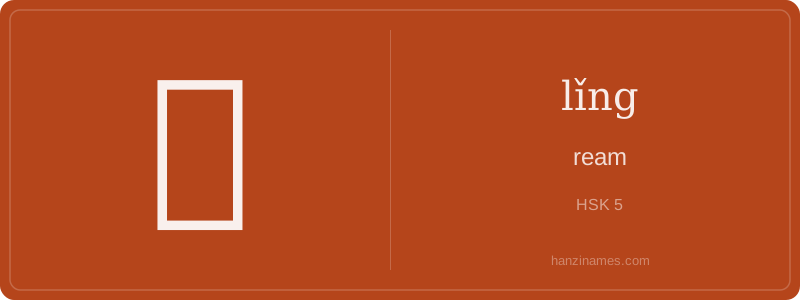
In daily life, 令 is used almost exclusively as a formal unit for bulk paper—especially in printing, publishing, and office supply contexts. It appears on invoices, packaging labels, and procurement documents across Greater China and overseas Chinese printing industries. Common phrases include '一令纸' (yī lǐng zhǐ) and '半令' (bàn lǐng), with usage documented in standards like GB/T 18358–2001 (Chinese national standard for paper measurement). The term remains stable despite digital shifts, underscoring institutional continuity.
The character’s earliest attested form (in bronze inscriptions, c. 11th–3rd BCE) depicts a kneeling person beneath a roof-like element—interpreted as a person receiving orders. It was not originally pictographic of paper, but of authoritative instruction. Its use as a paper unit emerged much later (Qing dynasty onward), likely through semantic extension: just as an imperial 令 commanded action, a 令 of paper commanded a standardized batch—linking bureaucracy with material logistics.
The character 令 (lǐng/lìng) opens a window into the Chinese worldview where language, measurement, and authority intertwine. Though commonly taught as a classifier for paper (one 令 = 500 sheets), its deeper resonance lies in standardization—reflecting China’s millennia-old emphasis on uniform systems, from imperial edicts to modern industrial units. This dual role—as both a unit of quantity and a bearer of command—mirrors how Chinese culture often embeds social order within material practice.
Historically, 令 evolved from an ancient pictograph representing a commanding figure issuing decrees, later simplified into its current five-stroke form. Its radical 人 (person) anchors it in human agency: not passive measurement, but purposeful, socially sanctioned quantification. When counting paper by 令, one isn’t just tallying sheets—it’s acknowledging a standardized unit trusted across printing houses, government offices, and schools since at least the Ming dynasty.
This character reveals how Chinese thought treats measurement as relational and contextual—not abstract or universal. A 令 of rice paper differs from a 令 of newsprint; the unit adapts to material and function. Such flexibility within structure reflects the Confucian ideal of li (ritual propriety): fixed forms that serve living needs. Thus, 令 embodies harmony between rule and reality—a quiet testament to a worldview where even paper bears the imprint of collective agreement.
Example Sentences
Common Compounds
Similar Characters — Don't Mix These Up
Your First Step into Chinese Culture: Get a Chinese Name
Every journey into Chinese begins with a name. Use our free Chinese name generator to create a meaningful, personalized Chinese name that fits you perfectly.
Get My Chinese Name →