余
Character Story & Explanation
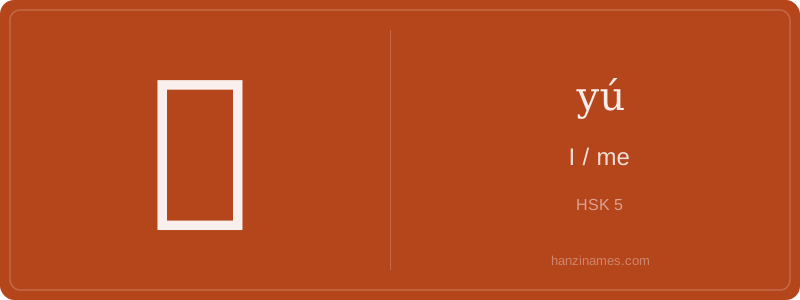
In classical Chinese literature and official documents up to the early 20th century, 余 served as a refined, humble first-person pronoun—especially among educated men writing essays, letters, or inscriptions. It appears frequently in Tang and Song dynasty poetry and prose (e.g., Su Shi’s prefaces), and survives today in formal registers, historical dramas, and idioms like 余音绕梁 (yú yīn rào liáng, 'lingering melody'), where 余 means 'remaining'. Modern usage is largely literary or rhetorical, rarely in casual speech.
The character’s seal script form shows a person (人 radical) with an extended arm holding something—possibly a grain measure—reflecting its original meaning 'surplus' or 'remainder'. This semantic root ('what remains') evolved into the pronoun 'I', implying 'the one who remains after roles are assigned'—a culturally grounded metaphor confirmed by Shuowen Jiezi (100 CE) and later lexicographers.
The character 余 (yú) embodies a subtle yet profound aspect of Chinese self-conception: the self as relational surplus—not isolated ego, but identity shaped by what remains after duty, role, and kinship. Historically used in classical texts like the Classic of Filial Piety, it conveys humility: 'I' is not a sovereign subject, but the gentle residue of obligations fulfilled. This reflects Confucian ethics where personhood emerges through proper relationships, not individual assertion.
In pre-modern registers, 余 was a modest first-person pronoun favored by scholars and officials—never boastful, always deferential. Its use signaled literacy and moral cultivation; choosing 余 over 我 (wǒ) implied restraint and awareness of social hierarchy. Even today, its presence in formal writing or literary contexts evokes elegance and classical poise, anchoring modern speech in centuries of ethical discourse on the situated self.
Unlike Western notions of 'I' as autonomous core, 余 suggests selfhood as permeable and contextual—a quiet presence defined by what one gives, leaves behind, or holds in reserve. This resonates with Daoist ideas of 'excess' (yú) as fertile ground for growth, and with Buddhist notions of non-attachment. Thus, 余 is not just grammar—it’s a worldview: the self as gracious remainder, never full, always open to relationship and renewal.
Example Sentences
Common Compounds
Similar Characters — Don't Mix These Up
Your First Step into Chinese Culture: Get a Chinese Name
Every journey into Chinese begins with a name. Use our free Chinese name generator to create a meaningful, personalized Chinese name that fits you perfectly.
Get My Chinese Name →