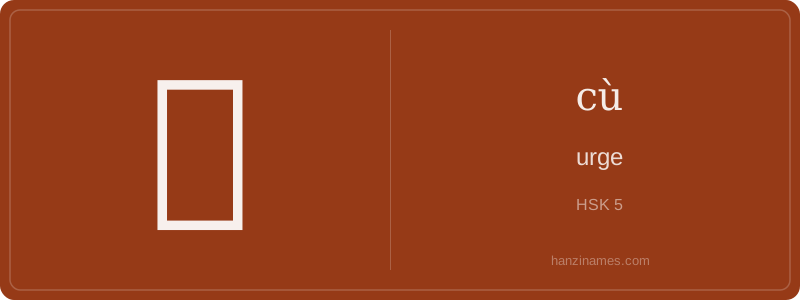
促
Character Story & Explanation
In daily Chinese life, 促 is most commonly found in official and professional language — especially in terms like 促进就业 (cùjìn jiùyè, 'promote employment'), a key phrase in China’s national economic planning since the 2000s, documented in State Council white papers and NPC reports. It also appears in widely used idioms such as 促膝长谈 (cùxī cháng tán, 'to talk intimately while sitting knee-to-knee'), reflecting its classical roots in respectful, earnest dialogue.
The character’s form evolved from seal script, where the right component resembled 少 (shǎo, 'few') — reinforcing the idea of reducing time or distance. There is no verified oracle-bone inscription for 促; its earliest confirmed usage appears in Han dynasty texts like the *Shuōwén Jiězì* (121 CE), defined as 'to urge forward' — confirming its long-standing role in expressing intentional, human-driven acceleration.
Hi students! Let’s learn 促 (cù), a Level 5 HSK character with 9 strokes and the 亻(person) radical. At its core, 促 conveys urgency — not just 'fast', but *causing* speed or shortening time: to urge, prompt, hasten, or stimulate. Think of it as the 'push' behind action — like a teacher urging students to finish work, or policy measures designed to accelerate economic growth. It’s rarely used alone; you’ll almost always see it in compound words.
The left side 亻shows human involvement — someone is actively prompting or initiating change. The right side 尐 (a variant of 少, meaning 'few' or 'little') hints at reduction — less time, less delay. So 促 literally suggests 'a person making something happen sooner'. This makes it very different from simple adjectives like 快 (kuài, 'fast') — 促 is about causation and intention, not just description.
Because it implies purposeful acceleration, 促 often appears in formal, modern contexts: government documents, business reports, education policy, and scientific writing. You’ll hear it in phrases like 促进 (cùjìn, 'to promote') or 督促 (dūcù, 'to urge'). While beginners might confuse it with similar-sounding characters, remember: 促 is about *initiating urgency*, not merely describing speed — and it carries a respectful, constructive tone, never rude or impatient.
Example Sentences
Common Compounds
Similar Characters — Don't Mix These Up
Your First Step into Chinese Culture: Get a Chinese Name
Every journey into Chinese begins with a name. Use our free Chinese name generator to create a meaningful, personalized Chinese name that fits you perfectly.
Get My Chinese Name →