俱
Character Story & Explanation
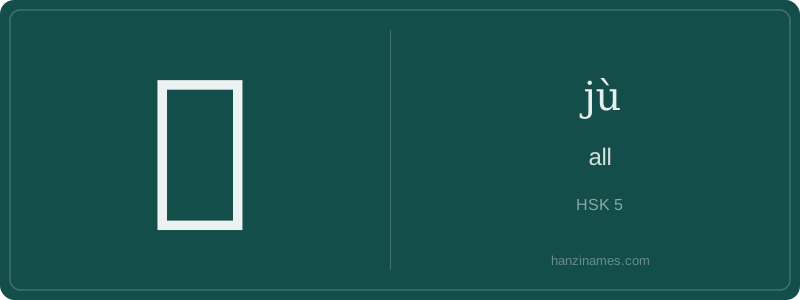
俱 appears frequently in formal written Chinese—especially in classical allusions, official documents, and literary idioms. A well-documented phrase is 万籁俱寂 (wàn lài jù jì), meaning 'all sounds are silent', used since the Tang dynasty to evoke profound stillness in poetry and prose. It’s also standard in modern legal and administrative language: e.g., '相关责任人员俱应依法处理' (all relevant personnel must be handled according to law), reflecting its enduring role in expressing universal applicability.
The character evolved from seal script, where 俱 combined 亻 (person) with 車 (chē, 'cart')—not as a pictograph of transport, but as a phonetic component. In ancient bronze inscriptions, 車 served as a sound loan for *jù*, while 亻 indicated human scope. No oracle-bone form survives; its earliest attested use is in Warring States bamboo slips, consistently meaning 'together' or 'all'.
The character 俱 (jù) embodies a foundational Confucian and Daoist sensibility: harmony through inclusive wholeness. Unlike English 'all'—which can imply mere quantity—俱 carries an ethical weight: it suggests moral completeness, where no one is excluded from duty, compassion, or consequence. This reflects the classical Chinese worldview that reality is relational; 'all' is not a statistical sum but a web of interdependent beings, each integral to the whole.
In classical texts like the *Zuo Zhuan* and Tang poetry, 俱 appears in contexts demanding collective accountability—'all officials', 'both friends', 'entirely present'. Its use avoids hierarchical singling out; instead, it affirms shared presence and mutual responsibility. This linguistic inclusivity mirrors the cultural ideal of *hé* (harmony), where unity isn’t uniformity but coordinated coexistence.
Modern usage retains this resonance: in legal documents, news reports, or education policy, 俱 signals non-discrimination and universal application—e.g., 'all citizens enjoy equal rights' (公民权利俱受保障). Even in digital life, netizens use 俱 in memes like '全网俱惊' (the entire internet was stunned), preserving its classical force: not just 'everyone', but *everyone, without exception*, bound by shared context and emotion.
Example Sentences
Common Compounds
Similar Characters — Don't Mix These Up
Your First Step into Chinese Culture: Get a Chinese Name
Every journey into Chinese begins with a name. Use our free Chinese name generator to create a meaningful, personalized Chinese name that fits you perfectly.
Get My Chinese Name →