催
Character Story & Explanation
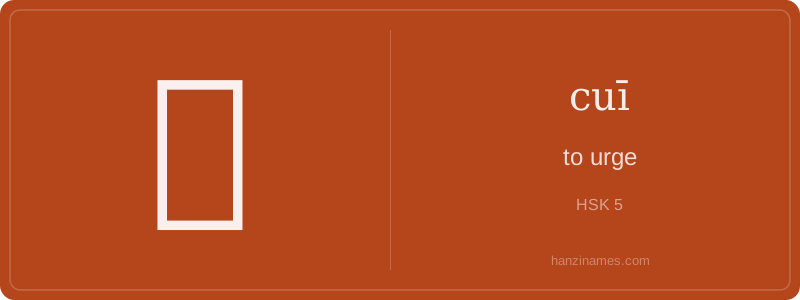
In modern Chinese, 催 is ubiquitous in professional and familial contexts: project managers 催进度 (cuī jìndù, 'urge progress'), landlords 催房租 (cuī fángzū, 'urge rent payment'), and parents 催婚 (cuī hūn, 'urge marriage')—a well-documented sociolinguistic phenomenon tied to China’s shifting demographics and intergenerational expectations. The phrase 催命符 (cuī mìng fú, 'death-summoning talisman') appears in Ming-Qing vernacular fiction, metaphorically labeling urgent, inescapable demands.
The character is not pictographic but phono-semantic: 亻 (person) + 隹 (phonetic, originally 'bird', now read cuī). No oracle bone form exists for 催—it first appears reliably in Han-era bamboo slips. Today, a common real-life scene is a WeChat group where a team leader sends '请尽快提交!' followed by 催一下~ ('Just a gentle nudge!')—capturing its polite yet persistent tone.
Our detective work begins with the radical 亻—'person'—a clear signal this character involves human action. To the right sits 隹 (zhuī), an ancient pictograph of a short-tailed bird, later repurposed phonetically. In bronze inscriptions and early seal script, 催 appears as a compound emphasizing agency: a person initiating motion or pressure on another. Its structure tells us urgency isn’t abstract—it’s interpersonal, intentional, and embodied.
Historically, 催 evolved from verbs meaning 'to press down' or 'to push forward', gaining its modern sense of 'urging' by the Han dynasty. Unlike passive terms like 促 (cù), which implies external constraint, 催 carries volition: one person actively prompting another—be it a teacher, employer, or parent. This nuance is embedded in its phonetic component’s historical pronunciation shift, aligning with Middle Chinese *tsʰuʌi, reinforcing imperativeness.
By the Tang and Song dynasties, 催 appears frequently in poetry—not as coercion, but as poetic catalyst: 催花 (cuī huā, 'urge blossoms') evokes spring’s arrival; 催妆 (cuī zhuāng, 'urge makeup') refers to pre-wedding rituals where guests urged the bride to finish dressing. These usages reveal how 催 bridges social duty and gentle insistence—never brute force, always culturally sanctioned timing.
Example Sentences
Common Compounds
Similar Characters — Don't Mix These Up
Your First Step into Chinese Culture: Get a Chinese Name
Every journey into Chinese begins with a name. Use our free Chinese name generator to create a meaningful, personalized Chinese name that fits you perfectly.
Get My Chinese Name →