亿
Character Story & Explanation
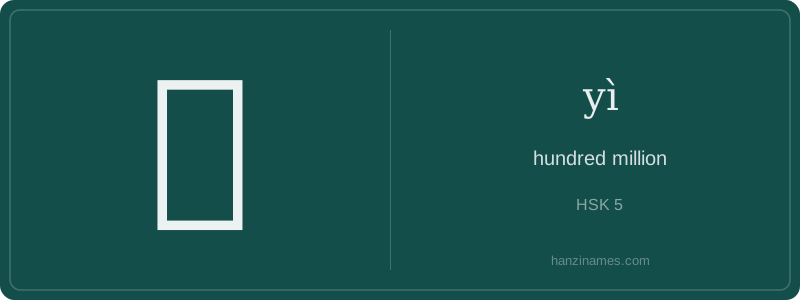
In daily life, 亿 appears ubiquitously in Chinese financial news, startup valuations, and government statistics — e.g., the 2023 report on '全国市场主体达1.7亿户' (China’s registered market entities reached 170 million). It’s also central to idioms like 亿万斯年 (yì wàn sī nián), meaning 'countless years', used in formal speeches and inscriptions to convey enduring legacy. The term 亿万富翁 (yì wàn fùwēng), 'hundred-millionaire', is far more common than 'billionaire' in domestic media, reflecting local numerical framing.
The character 亿 is a simplified form of the traditional 億, first standardized in the 1956 Chinese Character Simplification Scheme. Its modern shape combines the radical 亻 (person) with the phonetic component 乙 (yǐ), a borrowing for sound — not meaning. There’s no pictographic origin; it’s a phono-semantic compound developed for administrative efficiency, not ancient symbolism.
The Chinese character 亿 (yì) represents the numeral '100 million' (10⁸), a unit deeply embedded in China’s financial, demographic, and technological discourse. Unlike Western systems that commonly use 'billion' (10⁹) as a benchmark for large-scale metrics, Chinese speakers default to 亿 when discussing national GDP figures, tech valuations, or population subgroups — making it a cultural and cognitive anchor for magnitude. Its frequent appearance in headlines (e.g., '亿万富翁') underscores its role not just as a number, but as a symbol of scale and aspiration.
Historically, 亿 entered formal usage during the Northern and Southern Dynasties (5th–6th c. CE) as part of the 'myriad myriad' (万万) system, later standardized under the Ming and Qing dynasties. Though Western media often misrenders '2 billion people' as '20 亿', the accurate equivalence is '2,000 million = 20 亿' — revealing how the character compresses large values more efficiently than English. This structural compactness aids rapid comprehension in high-stakes contexts like stock market reports or census announcements.
Compared to Western equivalents like 'hundred million', 亿 carries subtle pragmatic weight: it signals official, authoritative scale — think national budgets or Fortune 500 China rankings. In contrast, English speakers rarely utter 'hundred million' outside technical or academic settings; 'billion' dominates colloquial large-number discourse. Thus, mastering 亿 isn’t just about numeracy — it’s about decoding how Chinese institutions and media frame size, success, and societal impact through lexical economy.
Example Sentences
Common Compounds
Similar Characters — Don't Mix These Up
Your First Step into Chinese Culture: Get a Chinese Name
Every journey into Chinese begins with a name. Use our free Chinese name generator to create a meaningful, personalized Chinese name that fits you perfectly.
Get My Chinese Name →