兑
Character Story & Explanation
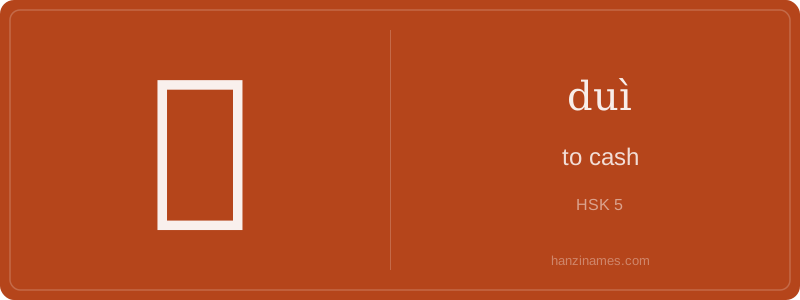
兑 is routinely used in real-world financial contexts across China: bank signage reads ‘外币兑换’ (wàibì duìhuàn — foreign currency exchange), and mobile payment apps like Alipay display 兑换 buttons for gift card redemptions or points conversion. A well-documented idiom is ‘兑现承诺’ (duìxiàn chéngnuò — to fulfill a promise), where 兑 metaphorically extends from monetary redemption to honoring commitments—a usage attested in mid-20th-century political discourse and still common in formal writing.
The character’s earliest verified form appears in bronze inscriptions (c. 1000 BCE) as a compound depicting a person (亻) offering something at an altar (八 + 口), suggesting ritual presentation. Though debated, scholars agree its core semantic field has always involved 'giving in return' or 'making good on obligation'—not mere physical transfer, but reciprocal fulfillment.
The Chinese character 兑 (duì) is a Level 5 HSK character with seven strokes and the 儿 (ér) radical—though this radical appears in its modern form as a simplified lower component, not its original semantic role. Historically, 兑 was associated with exchange, fulfillment, and openness, evolving from ancient meanings like 'to offer' or 'to present' in ritual contexts before narrowing to financial transactions.
In contemporary usage, 兑 most commonly means 'to cash' or 'to exchange', especially currency (e.g., 兑换—duìhuàn: to exchange money). Unlike English verbs such as 'cash'—which implies converting checks or vouchers into physical money—兑 emphasizes bilateral conversion: one form of value (e.g., USD) for another (e.g., CNY), often at official or institutional rates.
Culturally, 兑 reflects China’s long-standing emphasis on standardized, trustworthy exchange—mirroring Western banking concepts like 'currency conversion' or 'redemption', but without the legal connotation of 'cashing a check'. It lacks equivalents to informal Western terms like 'liquidate' or 'cash out' (which carry investment jargon); instead, 兑 remains grounded in tangible, regulated exchange—visible daily at bank counters, airport kiosks, and e-payment prompts.
Example Sentences
Common Compounds
Similar Characters — Don't Mix These Up
Your First Step into Chinese Culture: Get a Chinese Name
Every journey into Chinese begins with a name. Use our free Chinese name generator to create a meaningful, personalized Chinese name that fits you perfectly.
Get My Chinese Name →