兼
Character Story & Explanation
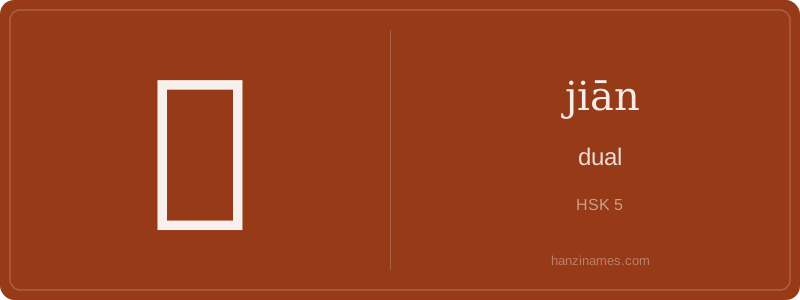
In modern Chinese, 兼 is indispensable in formal and professional contexts: it appears in job titles (兼任教授, 'concurrently serving professor'), policy documents (兼顾, 'to take into account both sides'), and idioms like 兼收并蓄 ('absorb and accommodate diverse elements'). It’s frequent in news headlines about balanced development—e.g., 经济发展与环境保护要兼顾 ('economic growth and environmental protection must be equally considered'). HSK 5 learners encounter it in academic reading and official discourse.
The character’s earliest attested form appears in Warring States bamboo manuscripts (c. 475–221 BCE), where it depicts two hands () above a simplified vessel or shelter (彐), signifying 'holding two things at once.' It was never a pictograph of natural objects but a semantic compound expressing coordinated agency—documented in excavated texts like the *Shanghai Museum Bamboo Slips*. No oracle bone form exists; its origin lies in early administrative writing, not divination.
As an archaeologist brushing dust from a Warring States bamboo slip, I find 兼 etched with crisp, angular strokes—no pictorial sun or beast, but a deliberate doubling: two hands () poised symmetrically over a vessel (彐), suggesting simultaneous holding. Early bronze inscriptions show it as a verb meaning 'to hold both'—not mere duplication, but intentional dual engagement, like grasping two reins at once. This isn’t arithmetic ‘two’; it’s the embodied logic of co-presence.
The character’s radical 丷 (‘clipping’ or ‘dividing’) is misleading at first glance—it doesn’t split, but frames. In seal script, 丷 emerges from stylized arms reaching outward, anchoring the upper field while the lower component 彐 (a covered hand or container) grounds the action. This structure reflects ancient administrative reality: officials *兼* held multiple posts—tax collector *and* granary overseer—without delegation, embodying integrated responsibility.
Unlike characters born from nature (e.g., 日 for ‘sun’), 兼 is a conceptual artifact—forged in bureaucracy, not oracle bones. Its ten strokes encode balance, not symmetry: the left-hand 丷 is slightly higher, the right-hand stroke of 彐 extends longer, mirroring how ‘dual roles’ in practice demand adaptive weight, not equal division. To write 兼 is to reenact that calibrated tension—between duty and capacity, between one body and two mandates.
Example Sentences
Common Compounds
Similar Characters — Don't Mix These Up
Your First Step into Chinese Culture: Get a Chinese Name
Every journey into Chinese begins with a name. Use our free Chinese name generator to create a meaningful, personalized Chinese name that fits you perfectly.
Get My Chinese Name →