冻
Character Story & Explanation
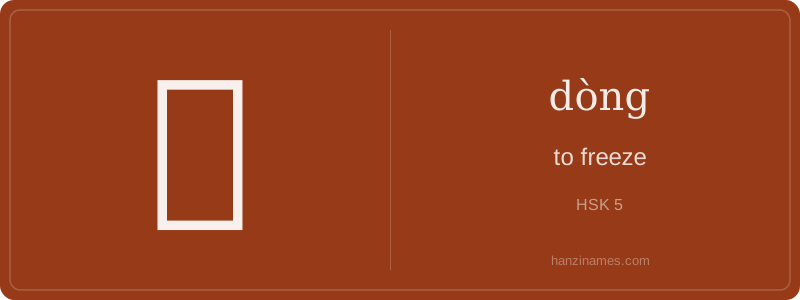
冻 is widely used in modern Chinese for freezing food, weather warnings, and bureaucratic processes — e.g., banks ‘freeze accounts’ (冻结账户, dòngjié zhànghù) under anti-money laundering laws, a documented practice since China’s 2006 Anti-Money Laundering Regulations. Common phrases include 冻伤 (dòngshāng, 'frostbite') and 冷冻食品 (lěngdòng shípǐn, 'frozen food'), a category regulated by China’s GB 2730-2015 national standard.
The character evolved from seal script, where 冫 represented ice and 东 served as a phonetic indicator — not a pictograph of ‘east’, but a borrowed sound component. No oracle-bone form exists for 冻; it first appeared in Han dynasty texts as a variant of 凍, later simplified to 冻 in 1956’s ‘Chinese Character Simplification Scheme’. Today, you’ll see it on freezer labels, weather apps, and government notices.
Hi students! Let’s learn 冻 (dòng), a Level 5 HSK character meaning 'to freeze' — both literally (water turning to ice) and figuratively (a body part going numb, or prices/stagnation freezing). It’s a verb, but also appears in nouns like 冰冻 (bīngdòng, 'frozen state') and adjectives like 冻结 (dòngjié, 'frozen/froze'). Notice the radical 冫 (two dots + vertical stroke) — it’s the ‘ice’ radical, always appearing on the left side of cold-related characters like 冷 (lěng, 'cold'), 凉 (liáng, 'cool'), and 冰 (bīng, 'ice'). This radical is your first clue: if you see 冫, think temperature drop!
The character has only 7 strokes — simple but precise. Stroke order matters: start with the two icy dots (冫), then the remaining five strokes form the phonetic component 东 (dōng, 'east'), which hints at pronunciation (dòng sounds close to dōng). Don’t confuse it with 东 — the bottom part of 冻 is simplified, not identical. Practice writing it slowly: dot, dot, vertical, horizontal, vertical, horizontal, horizontal — like sealing something tight with frost.
As a beginner, focus on common contexts: food (“This soup will freeze overnight”), weather (“The pipes froze”), and idioms (“His smile froze on his face”). Remember: 冻 is almost always transitive — it needs an object (e.g., 水冻了, 'the water froze') or passive construction (e.g., 肉被冻坏了, 'the meat got spoiled from freezing'). Also note its frequent pairing with 结 (jié) as 冻结 — a key term in finance, law, and daily life meaning 'to freeze (an account, assets, or progress).'
Example Sentences
Common Compounds
Similar Characters — Don't Mix These Up
Your First Step into Chinese Culture: Get a Chinese Name
Every journey into Chinese begins with a name. Use our free Chinese name generator to create a meaningful, personalized Chinese name that fits you perfectly.
Get My Chinese Name →