删
Character Story & Explanation
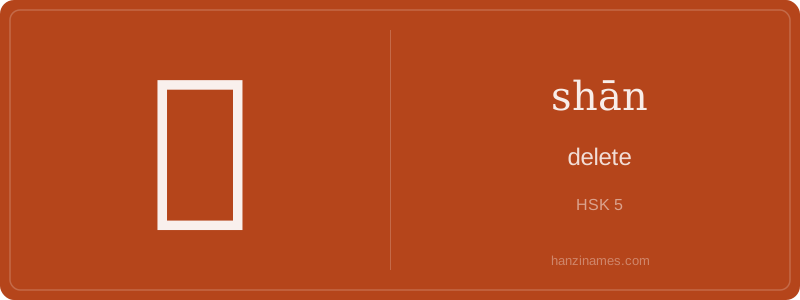
删 is widely used in contemporary Chinese digital and administrative contexts: ‘删除键’ (shānchú jiàn) means ‘delete key’, and ‘一键删除’ (yī jiàn shānchú) — ‘one-click delete’ — is standard interface terminology across WeChat, Weibo, and government e-service platforms. Historically, the character appears in Ming-Qing dynasty editorial prefaces, where scholars wrote ‘删繁就简’ (shān fán jiù jiǎn, ‘cut redundancy, embrace simplicity’) to describe textual revision of classics like the Records of the Grand Historian. It also appears in legal codes such as the Great Qing Code, referring to the formal excision of clauses.
The character 删 is a phono-semantic compound: the left component 竿 (gān, originally ‘bamboo pole’) hints at pronunciation (shān shares phonetic root with 竿 in Middle Chinese), while the right radical 刂 (dāo, ‘knife’) conveys meaning—cutting, removing. Its earliest attested form appears in Han dynasty clerical script, not oracle bone or bronze inscriptions, confirming its later emergence as a specialized editorial term.
The character 删 (shān) embodies a distinctly pragmatic and reflective aspect of the Chinese worldview: the conscious, deliberate act of removal—not as loss, but as refinement. In Confucian and Daoist traditions, editing, pruning, and cutting away excess are metaphors for self-cultivation and clarity of thought. Just as a gardener trims branches to strengthen the tree, 删 represents intellectual discipline: deleting redundancy to reveal essence, aligning with the classical ideal of 'less is more' expressed in texts like the Dao De Jing.
This character reflects China’s long literary and bureaucratic heritage—where scribes, editors, and imperial censors meticulously revised texts, edicts, and histories. Deletion was never arbitrary; it carried moral, political, and aesthetic weight. To 删 was to exercise judgment, responsibility, and authority—whether excising an imprecise phrase from a poem or redacting sensitive content from official records. Thus, 删 encodes respect for precision, hierarchy of information, and the ethics of omission.
In modern digital life, 删 retains this gravitas: pressing the ‘Delete’ key on a smartphone or editing a WeChat post echoes centuries-old editorial practices. Yet unlike Western notions of deletion as erasure or negation, 删 implies intentional curation—removing what distracts from truth, harmony, or function. It reveals a cultural comfort with impermanence and revision: knowledge, language, and even identity are seen as dynamic, shaped by continuous, thoughtful subtraction as much as addition.
Example Sentences
Common Compounds
Similar Characters — Don't Mix These Up
Your First Step into Chinese Culture: Get a Chinese Name
Every journey into Chinese begins with a name. Use our free Chinese name generator to create a meaningful, personalized Chinese name that fits you perfectly.
Get My Chinese Name →