创
Character Story & Explanation
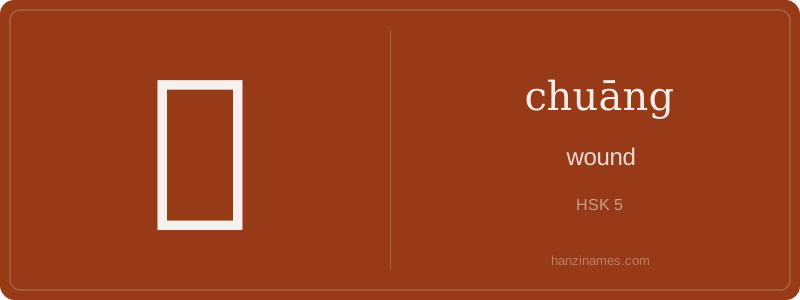
In contemporary China, 创 (chuāng) appears routinely in healthcare settings: emergency room whiteboards list '轻创' (qīngchuāng, 'minor wound') and '重创' (zhòngchuāng, 'severe injury'); the national standard GB/T 16180–2014 for work-related injury assessment uses 创 over 30 times to classify tissue damage. It’s central in idioms like 创巨痛深 (chuāng jù tòng shēn — 'a grievous wound, deep pain'), historically used in Qing-era memorials describing national humiliation.
The character’s form dates to seal script (c. 3rd century BCE), where it clearly combines 仓 (a simplified granary enclosure, symbolizing containment or vulnerability) with 刂 (knife). Archaeological inscriptions on bronze vessels from the Warring States period confirm this structure was already standardized for 'wounding' — no pictographic sun/moon/tree origin; it’s a semantic-phonetic compound with documented functional consistency for over 2,300 years.
The character 创 (chuāng) evokes the sharp, sudden reality of injury — not abstract, but visceral: a slip on wet tiles in a Beijing alleyway, a kitchen knife glancing off bone, the sting before blood wells. Its radical 刂 (knife) anchors it in physical action, while the top component 仓 (cāng) — originally meaning 'granary' — hints at containment and consequence. In classical usage, 创 consistently denotes wounding: wounds inflicted, wounds suffered, wounds that scar or heal.
This meaning remains alive in modern medical and legal Chinese. You’ll see it in hospital triage forms (创伤, chuāngshāng — 'trauma'), forensic reports ('造成创口', zàochéng chuāngkǒu — 'caused an open wound'), and even in historical texts like the *Records of the Grand Historian*, where it describes battlefield injuries. Unlike its homophone 创 (chuàng, 'to create'), this 创 carries no optimism — only gravity and precision.
Its dual pronunciation is a linguistic safeguard: context instantly disambiguates. Say 'chuāng' in a clinic, and everyone knows you mean injury; say 'chuàng' in a startup incubator, and it’s innovation. This phonetic split reflects how deeply Chinese distinguishes between rupture and renewal — two sides of the same radical, yet worlds apart in meaning and moral weight.
Example Sentences
Common Compounds
Similar Characters — Don't Mix These Up
Your First Step into Chinese Culture: Get a Chinese Name
Every journey into Chinese begins with a name. Use our free Chinese name generator to create a meaningful, personalized Chinese name that fits you perfectly.
Get My Chinese Name →