胜
Character Story & Explanation
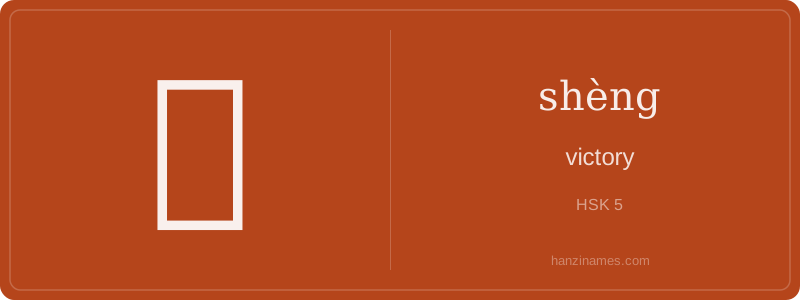
胜 is ubiquitous in modern Chinese: it appears in news headlines (‘中国队胜美国队’), legal documents (‘原告胜诉’ – ‘plaintiff prevails’), and daily speech (‘胜过他’ – ‘surpass him’). It anchors the famous idiom 百战百胜 (bǎi zhàn bǎi shèng, ‘victorious in every battle’), cited in Sun Tzu’s *Art of War* (c. 5th century BCE) and still used in business and sports contexts. The term 胜利 (shènglì, ‘victory’) commemorates major historical events, like the 1945 Victory over Japan Day (抗战胜利纪念日).
The character’s form has no verified pictographic origin—it’s a Warring States–era phono-semantic compound. Instead of ancient imagery, consider how Chinese students write it today: practicing stroke order on grid paper, chanting ‘撇、横、横、竖、横、撇、横、横、竖’ before exams—where mastering 胜 literally means ‘passing the test’.
As a linguistic detective, I begin at the scene: the modern character 胜 (shèng), nine strokes, radical ⺼ (‘flesh’ or ‘body’—a common semantic marker for states involving the human condition). At first glance, it appears abstract—but its components tell a story. The left side ⺼ signals embodiment; the right side 生 (shēng, ‘to be born’, ‘life’, ‘growth’) suggests vitality emerging from physical existence. This pairing implies triumph arising not from abstraction, but from lived, embodied effort.
Historically, 胜 evolved from seal script (c. 3rd century BCE), where its structure already fused ⺼ and 生. Unlike many characters with clear pictographic origins (e.g., 日 for ‘sun’), 胜 is phono-semantic: 生 provides both sound (early pronunciations of 生 and 胜 were closer) and meaning—victory as flourishing life, not mere conquest. Scholars like Karlgren and modern databases (e.g., Zhonghua Zihai, CBETA) confirm no oracle bone or bronze inscriptions contain 胜; it emerged later in standardized scripts.
The radical ⺼—often misread as ‘meat’—actually represents the body’s interior, including will, endurance, and visceral resolve. So 胜 isn’t passive success; it’s *earned* victory—rooted in stamina, strategy, and human agency. Its HSK 5 placement reflects this conceptual density: learners must grasp not just ‘win’, but layered uses—moral superiority (‘to surpass morally’), aesthetic excellence (‘superior in beauty’), and even legal verdicts (‘the court ruled in favor of…’).
Example Sentences
Common Compounds
Similar Characters — Don't Mix These Up
Your First Step into Chinese Culture: Get a Chinese Name
Every journey into Chinese begins with a name. Use our free Chinese name generator to create a meaningful, personalized Chinese name that fits you perfectly.
Get My Chinese Name →