勤
Character Story & Explanation
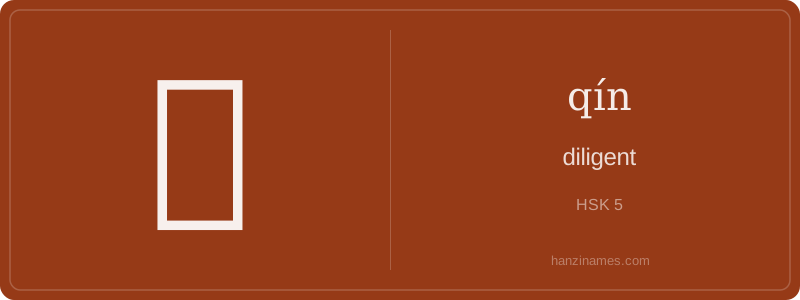
勤 is central to modern Chinese education and workplace values. It appears in the widely used idiom 勤能补拙 (qín néng bǔ zhuō) — 'diligence can compensate for lack of talent' — cited in official education guidelines and textbooks since the 1950s. In daily life, parents tell children 勤学苦练 (qín xué kǔ liàn, 'study diligently and practice rigorously'), and job evaluations often include 勤勉 (qínmiǎn, 'assiduousness') as a key metric. Historically, it was used in Ming and Qing dynasty civil service examinations to describe exemplary scholar-officials.
The character’s earliest attested form appears in seal script (c. 3rd century BCE), where 舁 (upper part) depicted two hands lifting a container, symbolizing cooperative effort, combined with 力 (force). This documented structure — not a pictograph of a person or tool — reflects its conceptual origin: diligence as shared, purposeful exertion.
Hello, learners! The character 勤 (qín) means 'diligent', 'industrious', or 'hardworking' — a highly valued virtue in Chinese culture. It’s composed of two parts: the left side 舁 (yú), an ancient form meaning 'to lift together', and the right side 力 (lì), meaning 'strength' or 'effort'. So visually, it suggests 'lifting with strength' — a vivid image of concerted, persistent effort. At HSK Level 5, it appears in academic, professional, and moral contexts, often paired with words like 学 (study) or 工作 (work).
This character carries strong positive connotations — not just working hard, but doing so thoughtfully and consistently. Unlike 累 (lèi, 'tired') or 苦 (kǔ, 'bitter'), 勤 focuses on the *attitude* and *habit* of diligence. You’ll see it in school mottos, performance reviews, and parental advice. Its tone is level (first tone), so practice saying 'qín' clearly and steadily — like the steady rhythm of diligent work itself.
While beginners may first meet it in compound words like 勤奋 (qínfèn, 'diligent'), mastering 勤 helps unlock deeper cultural ideas: Confucian emphasis on self-cultivation through sustained effort, and the belief that talent grows through practice — not just innate ability. Writing it requires careful attention to stroke order (13 strokes), especially the flowing curves in the upper left and the firm dot-stroke in 力. Each stroke reflects intentionality — much like the quality it represents.
Example Sentences
Common Compounds
Similar Characters — Don't Mix These Up
Your First Step into Chinese Culture: Get a Chinese Name
Every journey into Chinese begins with a name. Use our free Chinese name generator to create a meaningful, personalized Chinese name that fits you perfectly.
Get My Chinese Name →