勿
Character Story & Explanation
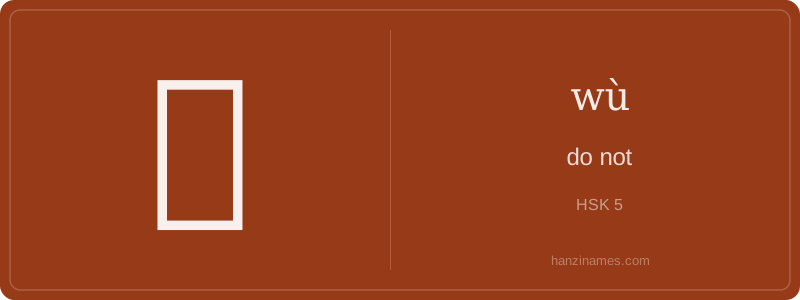
In modern Chinese, 勿 is formal, written-only negation—rare in speech but ubiquitous on signs, warnings, and official documents: '勿入' (Do Not Enter), '勿触摸' (Do Not Touch), '勿饮酒后驾车' (Do Not Drive After Drinking). It appears in classical idioms like 勿谓言之不预 (‘Don’t say you weren’t warned’) and in medical prescriptions (e.g., 勿与本品同服—‘Do not take with this medicine’).
Its earliest attested form is in Western Zhou bronze inscriptions (c. 10th–8th BCE), where it functions as a prohibitive particle, often preceding verbs. The character is not pictographic; it derives from a simplified variant of 毋 (wú), both sharing the same prohibitive function and phonetic lineage—no sun, moon, or axe involved. Its shape reflects scribal abbreviation, not ancient symbolism.
Unearthing 勿 from oracle-bone and bronze inscriptions reveals not a pictograph of prohibition, but a functional grammatical marker—its earliest forms show a curved enclosure (radical 勹) with a central stroke, likely indicating containment or cessation. Unlike emotive characters like 恐 (fear), 勿 emerged as a grammatical negator in ritual texts and legal pronouncements, where precision mattered more than imagery.
This character’s austerity—just four strokes—mirrors its function: absolute, unadorned negation. In Zhou dynasty bronze inscriptions, 勿 appears in mandates like '勿斃' (do not execute), underscoring its authoritative, imperative force. Its minimalism wasn’t artistic economy—it was bureaucratic necessity: clear, carveable, unambiguous.
Modern paleography confirms 勿 evolved from a phonetic-semantic compound, with 勹 (to wrap/enclose) suggesting restriction and the internal stroke possibly deriving from 毋 (wú, also 'do not')—a sister form sharing origin. No evidence supports folk etymologies linking it to ‘wiping away’ or ‘broken knife’. Its power lies in its starkness: no subject, no verb—just pure prohibition, echoing across three millennia of Chinese legal, medical, and ethical discourse.
Example Sentences
Common Compounds
Similar Characters — Don't Mix These Up
Your First Step into Chinese Culture: Get a Chinese Name
Every journey into Chinese begins with a name. Use our free Chinese name generator to create a meaningful, personalized Chinese name that fits you perfectly.
Get My Chinese Name →